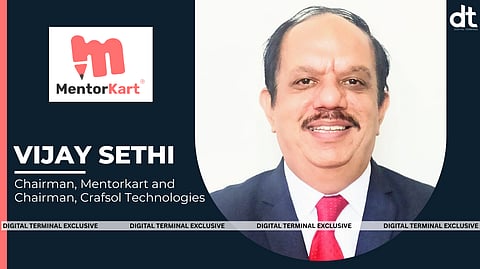

Authored by Vijay Sethi, Chairman Mentorkart and Chairman, Crafsol Technologies
As we cross the threshold into 2026, the familiar contours of the Chief Information Officer’s (CIO’s) role is being fundamentally redrawn. For decades, CIOs mandate has been to build on the "Three Rs": Reliability, Resilience and ROI. While these remain the bedrock of good IT leadership, they are no longer the ceiling. IT is no longer the back office. CIO is no longer the leader of a support function. That era is long behind us.
The transition from 2025 to 2026 marks a clear inflection point across the CIO agenda. Just to give few examples,
In AI, the conversation has already moved from AI bots, vision cameras and predictive analytics to Agentic AI and multi-agent systems and autonomous workflows capable of executing business decisions at scale.
The focus that CIOs had on data lakes and data warehouses is giving way to real-time data fabrics and private data exchanges, designed for speed, interoperability, and trust.
Similarly, in cybersecurity, perimeter-led defences are no longer sufficient. The new baseline is zero trust, reinforced by quantum-safe cryptography.
And perhaps most importantly, how the success of CIO is measured is also evolving – From Uptime and budget adherence to revenue impact and AI-driven returns on investment.
CIOs and IT teams of 2026 are no longer the Flight Engineers keeping the aircraft maintained. They are the Co-Pilots, helping set the strategic trajectory of the business itself. The data-driven era has matured. We are moving past the novelty of generative experiments into the era of Agentic Orchestration and Digital Sovereignty. In this landscape, leadership must evolve from managing infrastructure to orchestrating intelligence.
CIOs are now among the principal architects of a company’s destiny. The year ahead will not reward the fastest adopters, but the most deliberate leaders. Those who can balance the radical speed of AI with the steady hand of governance and the clear focus of business value will win the game. Let me talk of 4 key areas that CIOs and IT teams should focus on in 2026
a) Shift From Information to Intelligence
b) Agentic Governance to Manage Digital Teams
c) Relentless Focus on Business Value
d) Reducing the Organizational Learning Lag
Shift From Information to Intelligence
In all these years, the “I” in CIO has stood for Information. In 2026, it must stand for Intelligence. We are transitioning from Information Technology to Enterprise Technology (ET). The distinction is not semantic. Information is passive. Intelligence, however, is active. It senses, decides and acts.
CIO and teams must shift their focus from trying to implement Dashboards to Composite AI workflows. The goal is no longer to provide reports and graphs that tell a manager what happened, but to deploy autonomous agents that sense a supply chain disruption and re-route inventory before the manager even logs in.
The 2-point principle is simple. Firstly, do not build systems that wait for human input. Then, build ecosystems that provide autonomous leverage across every enterprise.
Agentic Governance to Manage Digital Teams
Governance once meant managing access controls, patch cycles, perimeter defences, locking down etc. In 2026, that defensive posture is no longer sufficient. Today’s CIO must manage the Digital Teams, a sort of pseudo team of AI agents that can negotiate contracts, move funds, interact with customers, manage your social media and what not, in real time. Agentic governance is the shift from managing static code to governing behaviour. In this, we need to look at two realities:
The "Human-in-the-Loop" Fallacy: "Human-in-the-loop" is becoming a bottleneck, not a safety net. Reality is that at enterprise scale, humans cannot supervise every micro-decision. Governance must evolve toward “governance by design”, where guardrails, constraints and ethical boundaries are embedded directly and firmly into an agent’s objective functions.
The Auditability of Intent: When intelligent systems fail, the root cause is rarely a simple bug. It is often a drift in intent. CIOs must put systems that have an ability to reconstruct decision pathways and explain why an agent acted the way it did, not merely what it did. This capability will be critical for regulatory compliance and enterprise trust.
Relentless Focus on Business Value
The most effective CIOs and IT teams of 2026 will fundamentally need to be fluent in both deep technical architecture and the language of business outcomes. They should be able to understand and communicate both the deep technical architecture of neural networks and the nuances of a P&L statement. Technical fluency is now the baseline. Business empathy is the differentiator.
If an architect cannot explain how a vector database investment reduces customer churn, or improve days sales outstanding, the investment is a failure of leadership. In 2026, CIOs and IT organizations need to shift from service-optimized IT (ticket resolution and uptime), to value-optimized IT (revenue impact and margin improvement) and ensure that they have relentless focus on business value (and not on just POCs and experimentation)
Reducing the Organizational Learning Lag
Technology is evolving faster than enterprise’s ability to absorb it. A key challenge CIOs and IT teams face today is the growing organizational learning lag, the gap between the pace of technological change and the organization’s ability to absorb it.
This Learning Lag is the silent killer of various Digital transformation initiatives. It is not just about increasing training hours but also building a digital culture, a culture of adaptability and a culture where employees are encouraged to experiment on digital technologies – say, for example teams are empowered to create their own agentic teammates.
A Final Word
Before closing, I want to highlight another area that is very close to my heart - Sustainability. As stewards of enterprise technology, CIOs must also take ownership of reducing the organization’s carbon footprint. Sustainable technology practices are no longer optional. They need to be integral to responsible leadership and have to be part of the DNA of CIOs and IT teams.
Wishing you a thoughtful, peaceful and successful year ahead!
𝐒𝐭𝐚𝐲 𝐢𝐧𝐟𝐨𝐫𝐦𝐞𝐝 𝐰𝐢𝐭𝐡 𝐨𝐮𝐫 𝐥𝐚𝐭𝐞𝐬𝐭 𝐮𝐩𝐝𝐚𝐭𝐞𝐬 𝐛𝐲 𝐣𝐨𝐢𝐧𝐢𝐧𝐠 𝐭𝐡𝐞 WhatsApp Channel now! 👈📲
𝑭𝒐𝒍𝒍𝒐𝒘 𝑶𝒖𝒓 𝑺𝒐𝒄𝒊𝒂𝒍 𝑴𝒆𝒅𝒊𝒂 𝑷𝒂𝒈𝒆𝐬 👉 Facebook, LinkedIn, Twitter, Instagram
