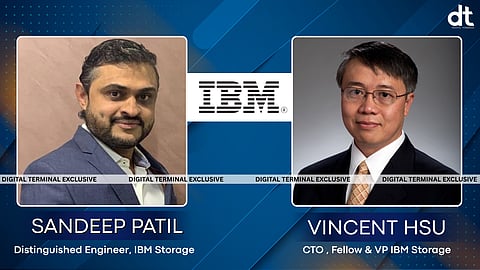

Authored by Vincent Hsu, CTO , Fellow & VP IBM Storage, Sandeep Patil, Distinguished Engineer, IBM Storage
In today’s enterprise landscape, AI has significantly changed how CIOs think about technology. Storage, once considered a back-office utility quietly running in the basement, is now firmly in the boardroom. As AI moves from pilots to mainstream business workloads, enterprise storage must simultaneously evolve to handle new levels of performance, data volume, governance, and cost pressure. The organizations that get this right will be the ones best positioned to compete in 2026 and beyond.
There are several massive shifts underway with direct implications on modern storage strategies. CIOs need to be fully cognizant of these trends as they plan the next phase of infrastructure transformation.
The Era of AI Inferencing
The year 2026 will largely be defined by always-on AI inferencing. Enterprises are embedding AI models and Agentic AI into routine business processes like customer support, IT operations, analytics, and decision systems. Unlike training workloads that run periodically, inferencing is continuous. Thousands of AI agents may call models concurrently throughout the day. In this new model, the bottleneck is steadily moving away from raw GPU compute and toward data access and data feeding.
Traditional storage platforms were never designed for this kind of relentless, parallel demand. When AI-enabled applications cannot retrieve context fast enough, GPUs and AI services sit idle, driving up costs and hurting user experience. To avoid this, enterprises must adopt specialized high-performance architectures: NVMe all-flash systems, high-throughput parallel file systems, and scale-out object platforms capable of extremely fast random reads.
Modern AI frameworks and pipelines depend heavily on containerized environments. Most production AI applications now run inside Kubernetes or OpenShift clusters. This makes a strong case for converged compute-plus-storage platforms that are purpose-built for GPU-enabled containers. Such systems bring storage physically closer to the inferencing engines, improving throughput and reducing latency.
Newer networking approaches also play an important role. Technologies like RDMA and GPU Direct Storage enable faster movement of data between GPUs and the storage backend. Even traditionally slower protocols such as S3 object storage can be significantly accelerated when implemented over RDMA fabrics. For CIOs designing AI platforms, evaluating these high-speed protocols should be a major consideration.
Rise of Sovereign Foundations and Data Gravity
Another defining trend for 2026 is the rise of Sovereign Digital Foundations. Data gravity already dictates where enterprises prefer to compute. But increasing global regulations dictate whether they are even allowed to process certain data outside national boundaries.
Frameworks such as the EU AI Act and India’s DPDP Act 2023 impose strict requirements on handling sensitive information. Moving large volumes of regulated enterprise data to centralized global clouds for AI processing is becoming increasingly difficult. As a result, enterprises are shifting toward sovereign cloud deployments—either private on-prem environments or nationally certified public clouds. The new mantra is clear: “bring the AI to the data,” not the other way around.
For storage teams, this translates into concrete requirements. Platforms must guarantee physical data placement within approved jurisdictions. Logical geo-fencing must prevent accidental cross-border replication. Region-bound storage pools are needed so that not only primary data, but also metadata, snapshots, and backups remain sovereign. Equally important is encryption where keys are owned and managed by the customer, often through sovereign-controlled key managers.
Sovereignty is no longer just a compliance checkbox. It is becoming a strategic enabler. CIOs must ensure that their storage deployments align tightly with national and industry regulations, otherwise even the most advanced AI platforms will fail to deliver real business value.
Content-Aware Storage and Metadata Embroidery
Retrieval-Augmented Generation (RAG) is rapidly emerging as the dominant approach for enterprise AI. Instead of relying purely on pre-trained models, RAG allows AI applications to pull relevant organizational knowledge in real time. This is driving exponential growth in demand for RAG-ready storage fabrics.
Most enterprises today build separate RAG pipelines that copy data from file systems into dedicated vector databases. This duplication adds complexity and latency. A more modern approach is content-aware storage where the same underlying storage platform or converged or fused compute-plus-storage platforms directly supports vector indexes for RAG. When vectors are hosted natively over the data lake, deployments become simpler, faster, and more cost efficient.
At the same time, unstructured enterprise data is getting smarter. In 2026 we will see the rise of “Metadata Embroidery.” Files and objects—whether a PDF document, a design drawing, or a meeting recording—will increasingly be wrapped with AI-generated summaries, classifications, and business context. Storage will no longer just tell you what a file is, but what it means. For CIOs, investing in metadata-rich platforms will be key to unlocking enterprise knowledge for AI use cases.
The Emergence of the AI Factory
All these trends converge into a larger architectural blueprint: the AI Factory. An enterprise AI Factory is designed to manage the full AI lifecycle—data ingestion, model training, inferencing, and iterative optimization—with automation and governance embedded throughout. For CIOs, this represents a shift from “general purpose IT” to an industrial-scale engine that continuously transforms raw data into intelligent business outcomes.
In such factories, storage plays the role of the raw material supply chain. It must deliver extreme performance in latency and throughput, provide GPU-native connectivity, scale seamlessly across distributed sites, and support intelligent tiering to optimize costs. The goal is to keep GPUs running at 90–95% utilization so that expensive AI investments deliver maximum return.
Beyond core infrastructure, AI will also redefine how storage itself is managed. CIOs should evaluate platforms with strong AIOps and Agentic AI readiness (Eg: MCP Servers support) —systems that support autonomous monitoring, optimization roadmaps, and modern control planes. These capabilities will help future-proof infrastructure as enterprises deepen AI adoption.
The message for 2026 is straightforward. Build AI-first storage architectures. Understand the new demands of AI inferencing and sovereign regulations. Embrace content-aware data platforms. CIOs who plan storage strategically with these trends in mind will power the next phase of digital transformation and lead their organizations confidently into the era of enterprise AI.
𝐒𝐭𝐚𝐲 𝐢𝐧𝐟𝐨𝐫𝐦𝐞𝐝 𝐰𝐢𝐭𝐡 𝐨𝐮𝐫 𝐥𝐚𝐭𝐞𝐬𝐭 𝐮𝐩𝐝𝐚𝐭𝐞𝐬 𝐛𝐲 𝐣𝐨𝐢𝐧𝐢𝐧𝐠 𝐭𝐡𝐞 WhatsApp Channel now! 👈📲
𝑭𝒐𝒍𝒍𝒐𝒘 𝑶𝒖𝒓 𝑺𝒐𝒄𝒊𝒂𝒍 𝑴𝒆𝒅𝒊𝒂 𝑷𝒂𝒈𝒆𝐬 👉 Facebook, LinkedIn, Twitter, Instagram
