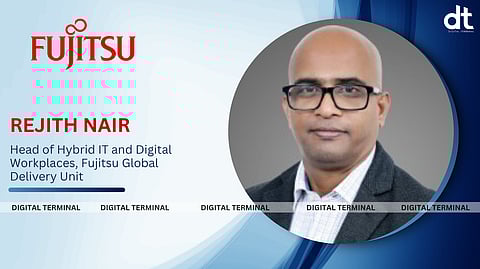

Authored by Mr. Rejith Nair, Head of Hybrid IT and Digital Workplaces, Fujitsu Global Delivery Unit
Amidst the rapidly evolving digital landscape in India, companies are under an immense pressure to innovate, scale, and still remain resilient in the face of mounting cyber threats and technological disruptions.
This ranges from the banking sector to retail brands, and from healthcare setups to manufacturing units. Digital transformation has become a strategic priority for each of them. However, the transformation would not be possible without a strong, scalable, and flexible foundation, hence, Hybrid IT has become the backbone of agile and resilient digital enterprises.
Various technologies like Generative AI (GenAI), Wi-Fi 7, cloud-native applications, and Internet of Things (IoT) have been redefining the operation of businesses, while CIOs and CTOs face the challenge of driving innovation while managing risks. According to NTT DATA’s Global GenAI Report, 64% of C-suite leaders expect their industries to carry out significant transformation by 2025 due to increased GenAI investments.
However, approximately 90% of them acknowledge the legacy infrastructure as a major bottleneck, as they’re not just outdated but restrictive. They hinder integration with modern technologies, raise operational costs, and expose businesses to security vulnerabilities. Organisations have increasingly embraced hybrid IT architectures, blending on-premises systems with public and private cloud environments to create a unifies, dynamic infrastructure, in order to overcome these limitations.
Hybrid IT refers to the strategic combination of traditional IT infrastructure with cloud-based resources to deliver greater operational flexibility, cost efficiency and responsiveness. This model has enabled businesses to select the optimal environment for each workload, for both on-premises for security-sensitive applications and on the cloud for scalability and speed. It transforms IT from a reactive cost into a proactive growth enabler, bridging the gap between innovation and legacy systems and laying the groundwork for technologies like AI, automation and data analytics to flourish.
The ability to adapt quickly in the digitally evolving landscape is non-negotiable as Hybrid IT empowers businesses to scale operations up or down in response to changing demands. For an instance, during a product launch or a peak retail season, enterprises can leverage the public cloud to manage traffic surges without investing in permanent infrastructure upgrades.
Resilient enterprises are not just reactive but are built to withstand shocks and recover swiftly. The layout facilitates this by enabling redundancy, failover mechanisms, and business continuity planning. Hybrid environments offer multiple recovery options that minimize downtime and protect customer faith during various conditions including a cyberattack, a natural disaster or system outage. Advanced disaster recovery solutions, data replication across geographies, and cloud-based backups ensure that services remain uninterrupted specially in the banking sectors even during crisis.
Hybrid IT enables organisations to make the most of their existing IT investments as companies choose to modernize selectively by retaining high-value legacy systems while integrating them with cloud-native platforms, rather than a complete overhaul.
The incremental modernization approach not only spreads costs over time but also ensures minimal disruption to business operations. Moreover, by adopting software-defined infrastructure and unifies licensing agreements, companies can simplify hardware and software management while reducing procurement complexities.
The cybersecurity landscape has become far more threatening than it has ever been, as organisations have been faced with ransomware, phishing and data breach risks on a regular basis. Hybrid IT allows enterprises to adopt a layered security approach, combining on-premises security controls with advanced cloud-based threat detection systems.
MFA and AI-driven anomaly detection have become mainstream as hybrid environments continue to offer superior protection compared to traditional setups, with zero-trust architectures. The setup also facilitates better compliance with mandates such as GDPR, HIPAA and PCI DSS, by ensuring that the data is stored and processed in accordance with jurisdictional requirements in regulated industries like healthcare and finance.
Adopting the Hybrid IT setup is not just a technical shift but a strategic evolution that includes some top-notch practices to be followed. This begins with evaluating current infrastructure and benchmarking it against industry standards, defining a roadmap that aligns IT architecture with broader business goals.
Thereafter, professionals must be engaged with industry certifications to translate complex strategies into actionable deployment plans as their expertise helps in faster rollout and ensures that new systems integrate seamlessly with legacy. Moving beyond break/fix supports by implementing proactive monitoring, automation tools, and centralized dashboards to manage operations is another vital step as this ensures better uptime, lower operational costs and improved compliance.
The integration of automation and AIOps (Artificial Intelligence for IT Operations) has further elevated the value of hybrid IT operations. AIOps platforms leverage machine learning to analyze massive volumes of IT data in real time, proactively identifying anomalies, predicting outages, and enabling self-healing responses without human intervention.
Automation streamlines routine tasks like patching, scaling, and configuration, freeing up IT teams to focus on strategic innovation. When paired with centralized monitoring tools and unified dashboards, AIOps ensure faster incident resolution, reduced downtime, and enhanced user experience creating an intelligent, responsive, and resilient IT ecosystem.
Apart from this, another step is finding ways to modernize and integrate the legacy systems instead of discarding them as technologies such as containerization and APIs can extend the life of older systems while aligning them with modern architectures. Adopting responsible IT practices such as equipment recovery, reuse, and circular resell to reduce electronic waste and improve ESG performance is equally critical. Using unified agreements that cover all technology solutions across the enterprise reduces administrative overhead and accelerates time to value.
Hybrid IT is not a transitional phase but a permanent fixture in the future of enterprise IT. As the pace of innovation accelerates, organisations that embrace hybrid environments will have a definitive edge in speed, resilience and responsiveness. The journey to digital transformation starts with a resilient infrastructure as Hybrid IT, by combining the best of both worlds, empowers enterprises to stay agile, protect their operations, and innovate at a large scale.
In a world where technology is the driver of value and differentiation, hybrid IT isn’t just a technical decision but a well-thought imperative. As enterprises prepare for the GenAI revolution, evolving threats, and ever-rising customer expectations, hybrid IT will continue to serve as the resilient backbone powering digital-first, future-ready organisations.
𝐒𝐭𝐚𝐲 𝐢𝐧𝐟𝐨𝐫𝐦𝐞𝐝 𝐰𝐢𝐭𝐡 𝐨𝐮𝐫 𝐥𝐚𝐭𝐞𝐬𝐭 𝐮𝐩𝐝𝐚𝐭𝐞𝐬 𝐛𝐲 𝐣𝐨𝐢𝐧𝐢𝐧𝐠 𝐭𝐡𝐞 WhatsApp Channel now! 👈📲
𝑭𝒐𝒍𝒍𝒐𝒘 𝑶𝒖𝒓 𝑺𝒐𝒄𝒊𝒂𝒍 𝑴𝒆𝒅𝒊𝒂 𝑷𝒂𝒈𝒆𝐬 👉 Facebook, LinkedIn, Twitter, Instagram
