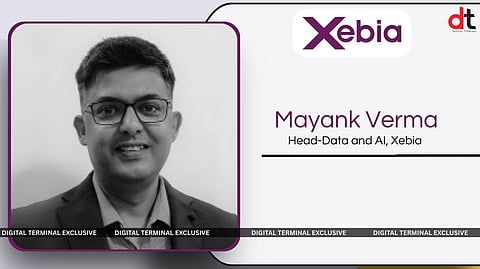

Authored by Mayank Verma, Head-Data and AI, Xebia
When most leaders talk about resilience, they think of backups, dashboards, or fast recovery. But true resilience isn’t about speed. It’s about timing—and the ability to recognize when conditions have changed before failure happens.
Why Prediction Isn’t Enough
Traditional AI systems were built on the idea that the future resembles the past. That assumption worked—until it didn’t.
During the 2021 supply chain crisis, Maersk responded to port congestion by adjusting not just schedules, but pricing logic. They offered premium slots for high-priority cargo and rerouted vessels dynamically. Their AI wasn’t just predicting delays. It was helping the business reframe priorities on the fly.
Compare that to other shipping companies that had equally sophisticated models—but failed to act. Their systems flagged bottlenecks, but couldn’t adapt because the core logic remained anchored to yesterday’s rules.
This is the problem: prediction-only AI waits to be told what matters. It doesn’t know when the game has changed.
Flexible Systems, Not Fortified Ones
Resilience today is less about defence and more about adaptability. That means designing systems that can reweight decisions, re-sequence logic, or escalate uncertainty—without needing to rebuild the model each time.
Three traits matter here:
Modular design, where perception, decision, and escalation layers can shift independently.
Event prioritization, where external signals can change what the system listens to.
Self-assessment, where AI can detect when its confidence drops and take appropriate action.
UPS made this shift with its ORION platform. Originally designed for delivery optimization, ORION now factors in variables like local fuel shortages or protests to reroute deliveries—without retraining. The system updates event importance, not just output.
What Agentic AI Looks Like
Agentic AI doesn’t just calculate. It adjusts. It can spot when a decision framework no longer fits, and apply a new one on its own.
In Amazon’s warehouses, robots reroute themselves when human pickers slow down or inventory layouts change. They reassign tasks, avoid blocked paths, and escalate exceptions when needed. They’re not just executing—they’re interpreting.
This is made possible by a layered design:
First, perception systems absorb real-time context.
Then, a rule evaluation layer checks if assumptions still hold.
If not, the execution engine applies new logic—or hands off to higher authority with explanation.
A similar structure powers JPMorgan’s fraud detection. When the system spots transaction patterns it hasn’t seen before, it doesn’t just flag them. It gauges whether its internal models still apply. If not, it reroutes the cases—complete with rationale—to human analysts.
These are not hard-coded handovers. They are flexible judgments made inside the system.
Better Metrics for Real Resilience
Traditional KPIs like uptime or recovery time don’t measure adaptive intelligence. New metrics are needed:
TRR (Time to Rule Reframe): How quickly the system adjusts logic when conditions shift.
At Amazon, routing logic shifts within minutes of local disruptions.
CDI (Confidence Deviation Index): Can the AI detect when its predictions are becoming unreliable?
Netflix uses this to suppress recommendations during new content surges.
EL (Escalation Latency): How fast can uncertainty be escalated to the right authority?
JPMorgan routes anomalies in seconds when internal confidence collapses.
These are not metrics for IT—they’re indicators of design maturity.
Perception as the Differentiator
In 2017, Delta Airlines suffered a major outage. Since then, it rebuilt its operations platform to read TSA wait times, aircraft rotation data, and crew availability in real time. The system no longer waits for disruption. It detects stress before it hits schedules.
This is the future of resilience: not failover systems, but perceptual systems that keep shifting their frame of reference as conditions evolve.
The Real Risk Is Relevance Collapse
Most enterprises won’t be caught off guard by a hack or a flood. They’ll be caught by something quieter: when their AI stops matching reality and no one notices.
𝐒𝐭𝐚𝐲 𝐢𝐧𝐟𝐨𝐫𝐦𝐞𝐝 𝐰𝐢𝐭𝐡 𝐨𝐮𝐫 𝐥𝐚𝐭𝐞𝐬𝐭 𝐮𝐩𝐝𝐚𝐭𝐞𝐬 𝐛𝐲 𝐣𝐨𝐢𝐧𝐢𝐧𝐠 𝐭𝐡𝐞 WhatsApp Channel now! 👈📲
𝑭𝒐𝒍𝒍𝒐𝒘 𝑶𝒖𝒓 𝑺𝒐𝒄𝒊𝒂𝒍 𝑴𝒆𝒅𝒊𝒂 𝑷𝒂𝒈𝒆𝐬 👉 Facebook, LinkedIn, Twitter, Instagram
