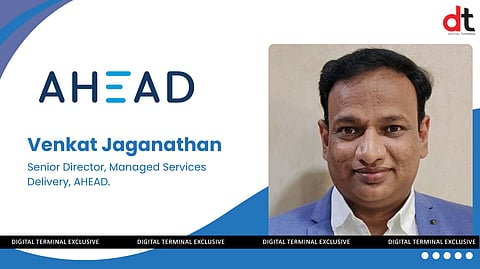

Authored by Venkat Jaganathan, Senior Director, Managed Services Delivery, AHEAD
Hybrid IT has become the new normal for enterprises navigating digital transformation. What began as a temporary bridge between legacy systems and the cloud is now a deliberate strategy: one that balances performance, regulatory needs, cost efficiency, and business agility. However, this distributed model has significantly complicated how security is designed, deployed, and measured.
Cyber threats have not only grown in volume but also in complexity. A fragmented infrastructure landscape creates multiple points of failure. The cost of a breach today is not limited to financial penalties. It affects business continuity, customer trust, and long-term growth. The responsibility to mitigate these risks sits squarely with leadership.
Security is no longer a back-end concern
In a hybrid architecture, every new workload, user identity, and integration introduces risk. The sheer volume of services spread across on-premise and cloud platforms means that traditional perimeter-based controls are no longer effective. Security must now be treated as a continuous layer that underpins every part of the enterprise.
What has changed most significantly is the nature of visibility. Inconsistent security policies across environments often mean that organizations do not know where sensitive data is flowing or who has access to what. This lack of clarity results in misconfigurations, over-provisioned permissions, and slow breach detection. These are operational issues, but they are also strategic risks that demand leadership focus.
Building a security architecture that moves with the business
Securing a hybrid enterprise requires more than just adding tools. It requires alignment across technology, people, and processes. Identity and access management needs to be central to this strategy. Every workload and user, whether internal or third-party, must be governed by well-defined policies and monitored in real-time.
Equally important is the ability to embed security directly into the development and deployment lifecycle. With the growing adoption of infrastructure-as-code and DevOps practices, the shift has to be leftward. Security should not slow down innovation; it should scale with it.
Resilience begins with preparation
The fastest-growing enterprises today are not the ones that avoid incidents altogether, but the ones that respond with speed and clarity. The question is not whether a security event will occur, but how prepared the organization is to contain it and recover.
This level of preparedness is not built overnight. It requires simulation, cross-functional coordination, and a culture where teams are incentivised to flag risks early. Investments in detection, response, and automated recovery are no longer optional. They are fundamental to protecting reputation and sustaining customer confidence.
The role of leadership
Security is not just the CISO’s problem. The most successful organisations are the ones where accountability is shared across the executive team. Whether the business is launching a new product, entering a new region, or onboarding a new cloud provider, security must be factored into the core planning process.
This mindset shift, where security is viewed as an enabler rather than a blocker, requires direct involvement from the CEO and board. It also requires leaders to ask the right questions: Are our teams aligned on the risk posture across all environments? Do we have a unified view of data movement? Are we building systems that can adapt to new threats as they emerge?
Conclusion
The hybrid IT model is here to stay. Its flexibility brings enormous value, but only if matched by an equal commitment to security. For enterprises that want to scale without compromise, the path forward is clear: simplify architecture, centralise control, and treat resilience as a strategic advantage. Security is now an enterprise-wide capability. And in today’s operating environment, it is one of the clearest indicators of long-term business health.
𝐒𝐭𝐚𝐲 𝐢𝐧𝐟𝐨𝐫𝐦𝐞𝐝 𝐰𝐢𝐭𝐡 𝐨𝐮𝐫 𝐥𝐚𝐭𝐞𝐬𝐭 𝐮𝐩𝐝𝐚𝐭𝐞𝐬 𝐛𝐲 𝐣𝐨𝐢𝐧𝐢𝐧𝐠 𝐭𝐡𝐞 WhatsApp Channel now! 👈📲
𝑭𝒐𝒍𝒍𝒐𝒘 𝑶𝒖𝒓 𝑺𝒐𝒄𝒊𝒂𝒍 𝑴𝒆𝒅𝒊𝒂 𝑷𝒂𝒈𝒆𝐬 👉 Facebook, LinkedIn, Twitter, Instagram
