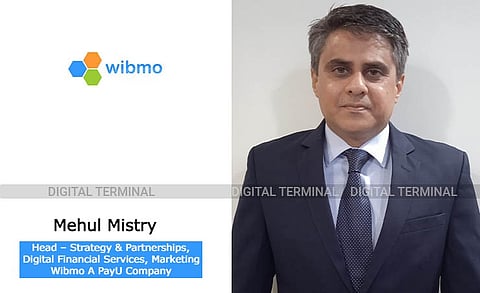

Authored by Mehul Mistry, Head – Strategy & Partnerships, Digital Financial Services, Marketing - Wibmo A PayU Company
Neo-Banking is going to be the next evolution of banking
Neobanks in India are digital interface offered by Fin-techs that gives customers an alternate method of banking and carry out financial transactions – Save, Pay, Invest and borrow/lend. They leverage technology and artificial intelligence to offer personalized services to customers while minimizing operating costs.
In India, these firms don't have a bank licence of their own but rely on bank partners to offer licensed services. That’s because the Reserve Bank of India (RBI) doesn’t issue full stack Universal Digital only bank license as in case of US and the European markets.
Central Bank has been following this space closely and recently 3rd Nov 2021, Niti Aayog, the premier policy think tank of the Government of India, providing directional and policy inputs, have issued draft discussion paper on Digital only bank regulatory framework for India. Central Bank has also set-up a fin-tech department to focus on the fast-growing segment in India, this new department will not only promote innovation in the fintech sector, but also identity the challenges and opportunities associated with it.
India has created digital infrastructure like JAM – Jandhan accounts, Aadhaar (Aadhaar Enable Payment System ) and Mobile Payments using Emerging Payment options like UPI. Other digital Infrastructure that has been created in India in recent past is Digi-locker, Digital vaccine certificate, Account Aggregation – Standardized platform/Consent layer that allows users to share their bank statements/transaction data basis their consents, OCEN (Open Credit Enablement Network) and ONDC (Open Network for Digital Commerce) will completely change the way Digital Commerce and Digital lending will happen in this country.
India’s embracing of open stack has profound implication for banks:
Banking services like Save, Pay, Invest and borrow/lending will start to originate on non-bank platforms in the year 2022. Potentially, e-commerce, edtech, food aggregators, and companies with offline channels such as retail companies, aviation brands, etc, could offer key banking services to end-consumers.
We will see Neo banks in India acquiring and servicing customer digitally, by end of year 2022 we could potentially see central bank issuing Neo/Digital Banking license in India.
Lending in India is poised for data driven transformation, payment transactions will increasingly get digitized and available in bank statements, Account aggregators and lenders via account aggregators will get access to machine readable bank statements, OCEN will create transparent competition on price and customer experience on digital platforms.
Real time payments using methods like UPI will further reduce ticket size, enormous volumes & digitized of P2M txn data. Small ticket high velocity lending like BNPL are poised to take off. In next 3 years, Account Aggregator and OCEN will disrupt lending like UPI has done to payments in 5 years.
We will see banks significantly investing in AI and upgraded tech stack, they will partner with digital platforms like Cred, Groww, Amazon, Swiggy, Phonepe etc to offer banking services. Financial services like Payments, Lending, Saving/Investments will move from traditional banks to non-banks in next 5 years and we will get to witness this starting 2022.
Projections in numbers
This can be corroborated by ongoing industry numbers. In FY 21, 55% of all payment transactions were carried out on traditional banking channels. By FY 26, this is slated to reduce to 25%, as 75% of the total retail payments will move to non-banking channels such as G-Pay, Amazon, PhonePe, BharatPe, Paytm, among others. In terms of lend, FY21 saw 35% transactions through banking channels, which will reduce to 20%. This means that 80% of lending transactions will be carried out on fin-tech paltforms like LazyPay, Slice, Zest, etc.
As far as Neo banking Savings/Investment are concerned, while FY 2021 saw only 2% of savings accounts offered on neo banking platforms, 2026 will see 25% of savings and investments activity happening on neo banking platforms such as FamPay, Jupiter, NiYo, etc.
Conclusion
Neo banks are the veritable future of banking transactions in India. As industry players continue to cross regulatory hurdles and create deeper roots within the financial ecosystem, users will switch to neo banks given the speed, convenience, and safety of neo banks.
