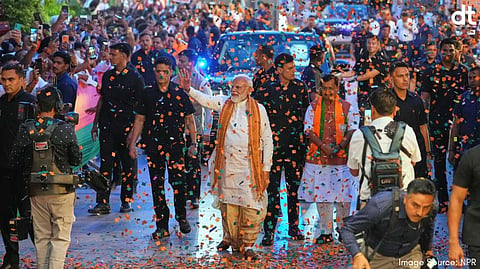

The Election Commission of India has officially concluded one of the most closely watched electoral cycles in recent years, announcing the final results of the 2026 Assembly elections across Tamil Nadu, West Bengal, Kerala, Assam, and the Union Territory of Puducherry. With constituency-level outcomes now sealed, the verdict reflects not just routine political turnover but a deeper churn in voter preferences, leadership acceptance, and regional aspirations.
This election cycle, marked by high voter turnout and intense multi-cornered contests, has delivered a mix of political upheavals, reaffirmed mandates, and the emergence of new power centers.

Tamil Nadu’s Political Reset: Vijay’s TVK Disrupts Established Order
Tamil Nadu has delivered perhaps the most dramatic outcome of the 2026 elections. In a state long dominated by entrenched Dravidian parties, actor-turned-politician Vijay has scripted a remarkable debut for his party, Tamilaga Vettri Kazhagam (TVK), which secured 107 seats to emerge as the single-largest party in the Assembly.
The scale of TVK’s success underscores a strong appetite for alternative leadership and a shift away from traditional party loyalties. The Dravida Munnetra Kazhagam, which was seeking to retain power, secured 60 seats, while the All India Anna Dravida Munnetra Kazhagam managed 47.
One of the defining moments of the election came in Kolathur, where TVK’s V S Babu defeated sitting Chief Minister M. K. Stalin by 8,795 votes. The result not only symbolizes a leadership setback but also highlights the depth of the political shift underway.
The state recorded an impressive voter turnout of over 85 percent, indicating heightened public engagement. Analysts view this as a reflection of both anti-incumbency sentiment and curiosity around a new political alternative that successfully converted popularity into electoral performance.
West Bengal’s Power Shift: BJP Secures Decisive Majority
West Bengal has witnessed a historic transition in governance, with the Bharatiya Janata Party winning 206 seats in the 294-member Assembly, comfortably crossing the majority threshold. This victory ends the long-standing dominance of the All India Trinamool Congress led by Mamata Banerjee, which had governed the state for over a decade.
The TMC’s tally dropped to 81 seats, marking a significant reversal in its electoral fortunes. The elections were conducted in two phases in April, with one constituency scheduled for re-polling, resulting in declared outcomes for 293 seats so far.
The scale of BJP’s victory points to a major realignment in voter sentiment, driven by a combination of political strategy, organizational expansion, and local dynamics. The outcome is likely to have far-reaching implications, not only for state politics but also for the national political narrative.
Kerala Chooses Change: UDF Returns to Power
In Kerala, the electorate has opted for a change in leadership, bringing the United Democratic Front, led by the Indian National Congress, back to power. The UDF secured 63 seats, enough to establish a clear governing position in the 140-member Assembly.
The Communist Party of India (Marxist), which led the outgoing government, was limited to 26 seats, indicating a shift in voter confidence. With a turnout of over 78 percent, the results suggest a decisive mandate rather than a fragmented verdict.
Kerala’s outcome reinforces the state’s pattern of alternating political power while also reflecting evolving voter priorities around governance and development.
Assam Reinforces BJP’s Stronghold in the Northeast
Assam has once again endorsed the BJP’s leadership, with the party winning 82 seats in the 126-member Assembly. This result marks a continuation of its electoral dominance in the state and underscores its sustained grassroots presence.
The Indian National Congress secured 19 seats, while regional allies Asom Gana Parishad and Bodoland People's Front added 10 seats each to the broader political landscape.
The outcome reflects a stable mandate, suggesting that voters have chosen continuity over change, particularly in a region where alliance dynamics play a crucial role.
Puducherry Maintains Status Quo with NDA Victory
In Puducherry, the National Democratic Alliance retained control, led by the All India N.R. Congress, which secured 18 seats in the 30-member Assembly. The opposition, led by the DMK alliance, was restricted to 6 seats.
The Union Territory recorded one of the highest voter turnouts in this election cycle, nearing 90 percent, reflecting strong democratic participation. The result signals voter preference for continuity and stability in governance.
A Broader Political Recalibration Underway
The 2026 Assembly election results collectively point to a broader recalibration of India’s political landscape. The emergence of new leadership in Tamil Nadu, a regime change in West Bengal, a clear mandate in Kerala, and continued dominance in Assam and Puducherry together illustrate the diversity of voter behavior across regions.
These outcomes are expected to influence political strategies, alliance formations, and governance priorities in the coming years. As parties recalibrate their approaches in response to these results, the ripple effects of this electoral cycle are likely to extend well beyond state boundaries, shaping the contours of future political contests across the country.
𝐒𝐭𝐚𝐲 𝐢𝐧𝐟𝐨𝐫𝐦𝐞𝐝 𝐰𝐢𝐭𝐡 𝐨𝐮𝐫 𝐥𝐚𝐭𝐞𝐬𝐭 𝐮𝐩𝐝𝐚𝐭𝐞𝐬 𝐛𝐲 𝐣𝐨𝐢𝐧𝐢𝐧𝐠 𝐭𝐡𝐞 WhatsApp Channel now! 👈📲
𝑭𝒐𝒍𝒍𝒐𝒘 𝑶𝒖𝒓 𝑺𝒐𝒄𝒊𝒂𝒍 𝑴𝒆𝒅𝒊𝒂 𝑷𝒂𝒈𝒆𝐬 👉 Facebook, LinkedIn, Twitter, Instagram
