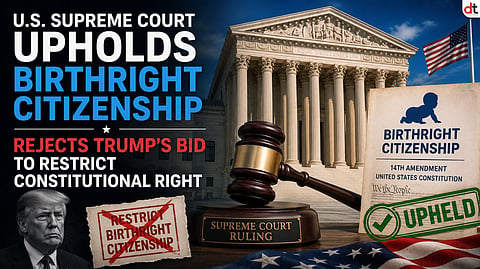

In a landmark constitutional ruling, the U.S. Supreme Court has reaffirmed the principle of birthright citizenship, rejecting an executive order issued by President Donald Trump that sought to limit automatic citizenship for certain children born in the United States.
The decision reinforces the long-standing interpretation of the 14th Amendment, confirming that, with very limited exceptions, anyone born on American soil is entitled to U.S. citizenship regardless of the immigration status of their parents.
Court Rejects Executive Order
The ruling strikes down President Trump's executive order, which argued that children born to individuals who were either living in the United States illegally or present on temporary visas should not automatically receive American citizenship.
The administration had sought to narrow the scope of the Citizenship Clause, contending that birthright citizenship should not extend to every child born within U.S. borders.
However, the Supreme Court declined to accept that interpretation, reaffirming decades of constitutional precedent.
14th Amendment Remains the Foundation
In reaching its decision, the justices relied on the established understanding of the 14th Amendment, which was adopted in 1868 following the American Civil War to guarantee citizenship rights.
The Court also referenced existing federal laws that have consistently recognized birthright citizenship as a constitutional guarantee.
The ruling confirms that nearly all individuals born in the United States automatically become U.S. citizens, except in limited circumstances, such as children born to accredited foreign diplomats or certain other narrowly defined exceptions.
Major Constitutional and Immigration Significance
The judgment represents one of the most significant constitutional rulings on immigration and citizenship in recent years.
Birthright citizenship has long been considered a cornerstone of U.S. constitutional law, providing automatic citizenship at birth regardless of ancestry, ethnicity, or parental immigration status.
Supporters argue that the principle promotes equal protection under the Constitution and prevents the creation of generations of stateless individuals. Critics, however, have maintained that the policy encourages unauthorized immigration, making it a recurring topic in American political debate.
A Defining Decision for U.S. Immigration Law
The Supreme Court's ruling preserves a legal framework that has remained largely unchanged for more than a century.
By rejecting efforts to redefine the Citizenship Clause through executive action, the Court has reaffirmed that any fundamental change to birthright citizenship would require constitutional amendment or congressional action consistent with constitutional protections.
The decision is expected to shape future debates on immigration policy while reinforcing one of the most enduring principles of American constitutional law.
𝐒𝐭𝐚𝐲 𝐢𝐧𝐟𝐨𝐫𝐦𝐞𝐝 𝐰𝐢𝐭𝐡 𝐨𝐮𝐫 𝐥𝐚𝐭𝐞𝐬𝐭 𝐮𝐩𝐝𝐚𝐭𝐞𝐬 𝐛𝐲 𝐣𝐨𝐢𝐧𝐢𝐧𝐠 𝐭𝐡𝐞 WhatsApp Channel now! 👈📲
𝑭𝒐𝒍𝒍𝒐𝒘 𝑶𝒖𝒓 𝑺𝒐𝒄𝒊𝒂𝒍 𝑴𝒆𝒅𝒊𝒂 𝑷𝒂𝒈𝒆𝐬 👉 Facebook, LinkedIn, Twitter, Instagram
