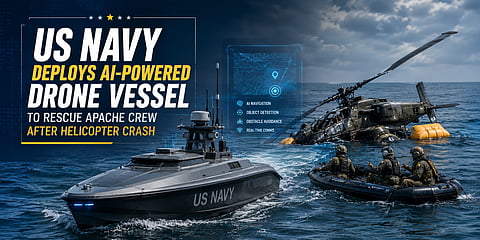

The United States military has successfully rescued two crew members from a crashed AH-64 Apache helicopter in a mission that highlighted the growing role of autonomous systems in modern warfare and rescue operations.
What makes the operation particularly significant is that the rescue was carried out with the support of an unmanned naval drone known as CORSAIR, an advanced autonomous surface vessel developed by Saronic Technologies . Unlike conventional drones that operate in the air, CORSAIR is designed to navigate across water without requiring a human crew onboard.
The operation was reportedly conducted by the US Navy's specialized Task Force 59, a unit focused on integrating artificial intelligence, autonomous systems, and unmanned technologies into maritime missions.
Task Force 59 Leads AI-Driven Naval Operations
Task Force 59 operates under the umbrella of the US Navy's Fifth Fleet, which is headquartered in Bahrain and oversees operations across strategically important waterways in the Middle East.
The unit has become known for testing and deploying next-generation technologies, including AI-powered surveillance systems, autonomous vessels, and unmanned maritime platforms.
According to US Central Command spokesperson Captain Timothy Hawkins, Task Force 59 successfully utilized the autonomous vessel during the recovery mission involving the downed Apache helicopter's crew.
The rescue demonstrates how autonomous maritime systems are increasingly moving beyond surveillance roles and becoming active participants in operational and humanitarian missions.
Meet CORSAIR: The Captainless Rescue Vessel
Developed in Texas-based Saronic Technologies, CORSAIR is a 24-foot autonomous surface vessel designed for long-range maritime operations.
The vessel can reportedly carry payloads of up to 1,000 pounds (approximately 450 kilograms) and is capable of traveling nearly 1,000 nautical miles, or about 1,850 kilometers, on a single mission.
With a top speed of approximately 35 knots (around 65 km/h), CORSAIR combines endurance with rapid response capabilities.
Its onboard technology suite includes artificial intelligence-powered navigation systems, advanced radar sensors, communication equipment, and autonomous decision-making capabilities that allow it to operate in complex maritime environments with minimal human intervention.
Military experts view such platforms as critical components of future naval operations, where autonomous systems can reduce risk to personnel while extending operational reach.
Questions Remain Over Apache Helicopter Incident
The rescue operation follows reports that a US Army AH-64 Apache helicopter crashed in the strategically important Strait of Hormuz region.
The incident attracted international attention after US President Donald Trump claimed that the helicopter had been brought down by an Iranian drone.
However, no official confirmation has been issued by Iranian authorities regarding any involvement in the incident, and the exact circumstances surrounding the crash remain unclear.
The Strait of Hormuz remains one of the world's most sensitive maritime chokepoints, carrying a significant portion of global energy shipments and frequently witnessing heightened military activity.
Autonomous Warfare Enters a New Era
The successful use of CORSAIR in a real-world rescue mission underscores a broader transformation taking place across global militaries.
Armed forces are increasingly investing in autonomous ships, AI-enabled surveillance systems, unmanned aerial vehicles, and robotic platforms to improve operational efficiency and reduce risks to personnel.
For the US Navy, initiatives led by Task Force 59 are seen as a testing ground for technologies that could shape future maritime warfare, logistics, reconnaissance, and rescue operations.
As geopolitical tensions continue to drive innovation in defense technology, missions like the Apache crew recovery offer a glimpse into how autonomous systems are becoming indispensable assets on the modern battlefield.
𝐒𝐭𝐚𝐲 𝐢𝐧𝐟𝐨𝐫𝐦𝐞𝐝 𝐰𝐢𝐭𝐡 𝐨𝐮𝐫 𝐥𝐚𝐭𝐞𝐬𝐭 𝐮𝐩𝐝𝐚𝐭𝐞𝐬 𝐛𝐲 𝐣𝐨𝐢𝐧𝐢𝐧𝐠 𝐭𝐡𝐞 WhatsApp Channel now! 👈📲
𝑭𝒐𝒍𝒍𝒐𝒘 𝑶𝒖𝒓 𝑺𝒐𝒄𝒊𝒂𝒍 𝑴𝒆𝒅𝒊𝒂 𝑷𝒂𝒈𝒆𝐬 👉 Facebook, LinkedIn, Twitter, Instagram
