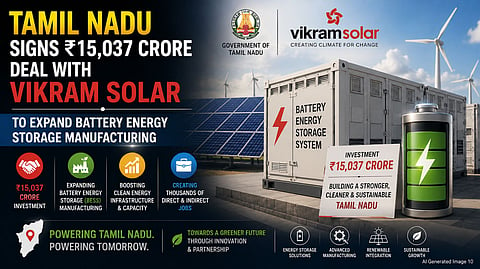

Tamil Nadu has taken another significant step toward strengthening India's clean energy manufacturing landscape by signing a Memorandum of Understanding (MoU) worth ₹15,037 crore with Vikram Solar. The agreement will pave the way for the establishment of a Battery Energy Storage System (BESS) manufacturing facility at SIPCOT Gangaikondan in Tirunelveli, reinforcing the state's position as a preferred destination for renewable energy investments.
The project is expected to generate approximately 2,670 direct and indirect employment opportunities, contributing to regional industrial growth while supporting India's broader transition toward sustainable energy infrastructure.
Strategic Expansion into Battery Energy Storage
The MoU was signed at the Tamil Nadu State Secretariat in the presence of Chief Minister M.K. Stalin, highlighting the state's continued focus on attracting high-value investments in future-ready industries.
Vikram Solar, one of India's leading renewable energy companies, already operates solar photovoltaic (PV) manufacturing facilities at Oragadam, Vallam, and Gangaikondan. With this new investment, the company will diversify into advanced Battery Energy Storage System manufacturing—an increasingly critical technology for enabling reliable integration of renewable energy into the electricity grid.
As solar and wind power generation continue to expand, battery storage solutions are becoming essential for balancing power supply, improving grid stability, and ensuring uninterrupted energy availability during periods of fluctuating renewable generation.
Tamil Nadu Deepens Its Clean Energy Leadership
Tamil Nadu has consistently emerged as one of India's leading destinations for renewable energy investments, supported by its industrial infrastructure, skilled workforce, and proactive manufacturing policies. The latest investment further strengthens the state's growing ecosystem spanning solar equipment, electric vehicles, batteries, electronics, and green technologies.
The development aligns with India's broader clean energy objectives, including expanding domestic manufacturing capabilities, reducing reliance on imports, and building resilient supply chains for next-generation energy technologies.
Battery Energy Storage Systems are expected to play a pivotal role in India's energy transition as the country increases the share of renewable power in its energy mix. These systems enable efficient storage of excess electricity generated during peak renewable production and supply power when demand rises or renewable output declines.
Supporting India's Net-Zero Vision
The expansion into BESS manufacturing reflects the increasing importance of energy storage in achieving India's long-term climate and energy security goals. As renewable capacity continues to grow, investments in advanced battery technologies are expected to become a key pillar of the nation's net-zero roadmap.
For Vikram Solar, the project represents a strategic move beyond solar module manufacturing into integrated clean energy solutions. For Tamil Nadu, it reinforces the state's ambition to evolve into a comprehensive clean energy manufacturing hub capable of serving both domestic and international markets.
With large-scale investments flowing into solar, battery technologies, electric mobility, and green manufacturing, India is steadily building a robust clean energy ecosystem. Projects such as Vikram Solar's proposed BESS facility not only strengthen industrial capacity but also position the country to play a larger role in the global renewable energy value chain.
𝐒𝐭𝐚𝐲 𝐢𝐧𝐟𝐨𝐫𝐦𝐞𝐝 𝐰𝐢𝐭𝐡 𝐨𝐮𝐫 𝐥𝐚𝐭𝐞𝐬𝐭 𝐮𝐩𝐝𝐚𝐭𝐞𝐬 𝐛𝐲 𝐣𝐨𝐢𝐧𝐢𝐧𝐠 𝐭𝐡𝐞 WhatsApp Channel now! 👈📲
𝑭𝒐𝒍𝒍𝒐𝒘 𝑶𝒖𝒓 𝑺𝒐𝒄𝒊𝒂𝒍 𝑴𝒆𝒅𝒊𝒂 𝑷𝒂𝒈𝒆𝐬 👉 Facebook, LinkedIn, Twitter, Instagram
