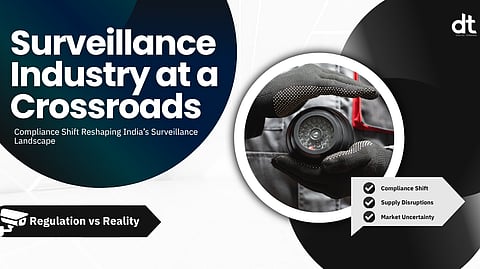

India's surveillance sector, and especially its CCTV segment, is going through an interesting phase in which it has reached a turning point where it must adopt itself to some new regulatory policies in the field. Indeed, some recently passed rules aim to enforce stronger compliance practices, establish cybersecurity measures, and ensure a safe and dependable surveillance structure in India. While the transition period allowed companies to adapt to new compliance standards during more than two years, they did not expect global challenges that made this process rather complicated.
We all agree that intentions behind such regulations are appreciated, several factors related to recent geopolitical disturbances may affect their execution.
This evolving situation calls for a balanced and pragmatic approach—one that aligns national security priorities with on-ground realities faced by businesses and stakeholders across the surveillance ecosystem.

Indeed, mandatory STQC certification of surveillance devices will become one of the crucial aspects that every company must observe in order to sell its products legally within India's borders. The new measures will contribute to improving the cybersecurity of infrastructure as a part of India's broader plans to build a reliable and self-sufficient digital landscape.
Unfortunately, it seems that despite the good intention of lawmakers to make surveillance products safer and more secure, the process of implementation may be rather challenging due to several problems that the surveillance industry has to face currently.
Current Market Challenges
The surveillance industry is currently facing multiple external pressures:
1. Persistent Chipset Shortage
The global semiconductor shortage continues to disrupt electronics manufacturing. CCTV cameras, being dependent on chipsets, are directly affected, leading to delays and increased costs.
2. Geopolitical Tensions
The ongoing conflict in West Asia has disrupted global logistics, affecting shipping routes, costs, and delivery timelines, which causes major inconveniences for businesses.
3. STQC Certification Bottlenecks
Limited government-approved testing labs have resulted in significant delays in certification, impacting product availability and project timelines. Due to the strict requirements for device certification and approval, manufacturers cannot deliver their products in time, which may lead to some problems with implementing new infrastructure projects.
4. Implementation Timing Challenges
Although the government provided over two years for compliance, global disruptions have made timely implementation difficult.
5. Higher Implementation Cost of Projects
Higher implementation costs are becoming a key concern for the industry. Rising prices, unavailability of materials, and ongoing supply chain disruptions are collectively increasing the overall cost of projects, making deployments more challenging.
6. Security Adoption Pressure Due to Inflation
Security adoption may face a slowdown as the challenge is not limited to the surveillance sector alone. The global economy is under pressure due to inflation control challenges driven by the West Asia war scenario, with prices of essential items increasing by around 10% or more, which is impacting overall investment sentiment.ment.
6. Rising Installation Costs
Installation costs are also rising as users today are more cautious and increasingly focused on best practice based deployments. This is creating a need for installers and engineers to upgrade their capabilities, become more professionally trained, and be better prepared to handle more demanding client expectations.
Market Sentiment
The overall industry sentiment remains cautious. While stakeholders support long-term standardization, short-term disruptions such as delays and cost pressures are creating uncertainty, especially for smaller players. We all believe that there is a pressing need to implement some strategies that would allow regulating surveillance activities in India efficiently. In particular, the government should introduce flexible conditions for the introduction of STQC certification since some companies do not have enough time to get certified before losing their customers and income.
Moreover, it may prove to be useful to expand the number of authorized testing centers to ease the process of certification.
1. Project Delays & Pipeline Impact
Industry sources indicate that nearly 60–70% of surveillance projects have seen delays in recent months, largely due to limited availability of STQC-certified products.
Industry estimates suggest that 60–70% of ongoing CCTV and surveillance projects (especially in government, smart city, and infrastructure segments) have experienced delays or slowdowns in the last few months due to compliance-related uncertainties.
Several tenders are either being re-evaluated or temporarily paused until clarity on certified product availability.
2. Inventory & Supply Constraints
While interacting with channel partners reported a growing inventory mismatch, where available stock cannot be deployed in new projects due to certification requirements.
Many distributors and system integrators are facing inventory mismatches—non-certified stock cannot be deployed in new projects.
Fresh imports or manufacturing batches are getting delayed due to certification bottlenecks.
3. Impact on Brands & OEMs
Several OEMs have products awaiting STQC approval for extended periods, impacting go-to-market timelines and new product rollouts
Fresh imports or manufacturing batches are getting delayed due to certification bottlenecks.
Both global and Indian OEMs are affected due to limited testing capacity.
Some companies reportedly have products stuck in certification queues for weeks to months.
4. Channel Partner Business Impact
System integrators and channel partners across India are witnessing slower order cycles and delayed revenue realization as project execution timelines stretch.
Revenue slowdowns
Delayed payments due to project hold-ups
Reduced order flow
5. Market Growth Slowdown (Short-Term)
While India’s surveillance market is projected for strong double-digit growth, the current transition phase may temporarily moderate momentum.
The Indian CCTV market was expected to grow at double-digit CAGR (12–15%), but in the short term, Growth may temporarily soften due to regulatory transition.
6. Certification Capacity Gap (Key Insight)
With a limited number of authorized labs and a large volume of products requiring certification, the current capacity is under significant strain
Limited number of STQC labs vs hundreds of brands and SKUs
Each product requires testing cycles that take weeks
Balancing Security with Sustainability
While the policy aims to strengthen national security, a rigid implementation during global uncertainty may affect business continuity and infrastructure development. A phased and supportive approach can ensure that the objectives of compliance and industry stability are achieved together.
The Case for a Phased Approach
Given the current scenario, a flexible implementation strategy could help:
Temporary extension of timelines
Transitional provisions for vendors already in certification process
Expansion of testing infrastructure
Continued stakeholder consultation
Conclusion
India’s surveillance market stands at a critical juncture. The new compliance norms have the potential to transform the ecosystem positively. However, current global and operational challenges require a pragmatic and collaborative approach. Reconsidering timelines and enabling smoother transitions will help build a resilient, secure, and future-ready surveillance ecosystem in India.
Indeed, it is vital to provide companies with some time to adapt to new requirements to avoid losses in the near future.
𝐒𝐭𝐚𝐲 𝐢𝐧𝐟𝐨𝐫𝐦𝐞𝐝 𝐰𝐢𝐭𝐡 𝐨𝐮𝐫 𝐥𝐚𝐭𝐞𝐬𝐭 𝐮𝐩𝐝𝐚𝐭𝐞𝐬 𝐛𝐲 𝐣𝐨𝐢𝐧𝐢𝐧𝐠 𝐭𝐡𝐞 WhatsApp Channel now! 👈📲
𝑭𝒐𝒍𝒍𝒐𝒘 𝑶𝒖𝒓 𝑺𝒐𝒄𝒊𝒂𝒍 𝑴𝒆𝒅𝒊𝒂 𝑷𝒂𝒈𝒆𝐬 👉 Facebook, LinkedIn, Twitter, Instagram
