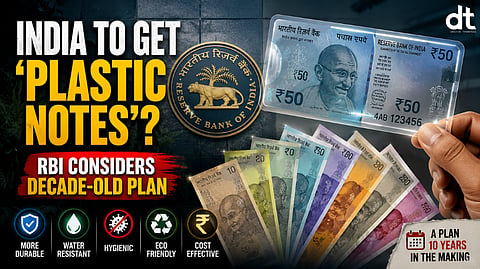

The Reserve Bank of India (RBI) is reportedly revisiting its long-standing proposal to introduce polymer banknotes in India, with discussions on launching a pilot project gaining momentum amid rising currency demand, increasing printing costs, and concerns over the short lifespan of paper currency notes.
According to multiple reports citing sources familiar with the matter, the proposal to introduce polymer or plastic-based banknotes was discussed during the RBI's recent board meetings held in Patna and Mumbai. A pilot rollout involving public circulation of polymer notes is expected to be announced in the near future.
Focus on Durability and Cost Efficiency

The move comes as the central bank evaluates ways to improve the efficiency of India's currency management system. Polymer notes are widely regarded as more durable than traditional paper-based currency and can remain in circulation significantly longer, reducing replacement requirements and overall production costs.
Sources indicate that advances in technology now make it feasible to integrate polymer notes into India's existing banking infrastructure, including automated teller machines (ATMs), which can be upgraded to recognize and dispense such currency.
The RBI's annual report revealed that expenditure on printing currency notes increased substantially during FY25. The central bank spent ₹6,372.8 crore on secure currency printing during 2024-25, compared with ₹5,101.4 crore in the previous fiscal year, primarily due to higher demand for banknotes.
Rising Volume of Soiled Currency
One of the key drivers behind the renewed interest in polymer notes is the growing number of soiled and damaged banknotes being removed from circulation each year.
Data from the RBI shows that approximately 23.8 billion pieces of soiled banknotes were disposed of during FY25, representing an increase of 12.3 percent compared to 21.24 billion notes in FY24.
The ₹500 denomination accounted for the largest share of disposed notes, followed by ₹100 banknotes. Since polymer notes generally have a much longer circulation life than paper notes, they could help reduce replacement cycles and lower currency management costs over time.
Earlier Pilot Was Shelved
The idea of polymer currency is not new in India.
In 2012, the government approved a field trial involving one billion ₹10 polymer banknotes across five cities. At the time, the primary objective was to increase the lifespan of currency rather than address counterfeiting concerns.
However, the initiative was eventually shelved due to technological and operational challenges, including compatibility issues with currency handling and processing systems.
Industry sources now suggest that technological advancements over the past decade have addressed many of those concerns, making a fresh attempt more practical and economically viable.
Global Adoption of Polymer Currency
Polymer banknotes have gained widespread acceptance across the world due to their durability, security features, and resistance to wear and tear.
More than 60 countries have introduced polymer currency into circulation. Australia pioneered the technology in 1988 with the launch of a polymer ten-dollar note. Countries including Singapore, Canada, Malaysia, Indonesia, Thailand, and Romania have also adopted polymer-based currency systems.
Canada began issuing polymer banknotes in 2011, while several Asian economies have reported lower replacement costs and improved note quality after transitioning from paper currency.
Part of a Broader Currency Management Strategy
The RBI has also been attempting to promote greater use of coins to reduce reliance on lower-denomination banknotes. However, public adoption has remained limited despite increased coin production.
The supply of coins rose from approximately 1.2 billion pieces in FY24 to 1.5 billion pieces in FY25, with ₹5 and ₹20 denomination coins accounting for a significant share of production.
As cash continues to play an important role in India's economy despite growing digital payment adoption, the introduction of polymer banknotes could represent a major modernization step in the country's currency management framework.
If approved, the pilot project would mark the first significant move toward plastic currency in India and could eventually pave the way for wider adoption of polymer banknotes across multiple denominations.
𝐒𝐭𝐚𝐲 𝐢𝐧𝐟𝐨𝐫𝐦𝐞𝐝 𝐰𝐢𝐭𝐡 𝐨𝐮𝐫 𝐥𝐚𝐭𝐞𝐬𝐭 𝐮𝐩𝐝𝐚𝐭𝐞𝐬 𝐛𝐲 𝐣𝐨𝐢𝐧𝐢𝐧𝐠 𝐭𝐡𝐞 WhatsApp Channel now! 👈📲
𝑭𝒐𝒍𝒍𝒐𝒘 𝑶𝒖𝒓 𝑺𝒐𝒄𝒊𝒂𝒍 𝑴𝒆𝒅𝒊𝒂 𝑷𝒂𝒈𝒆𝐬 👉 Facebook, LinkedIn, Twitter, Instagram
