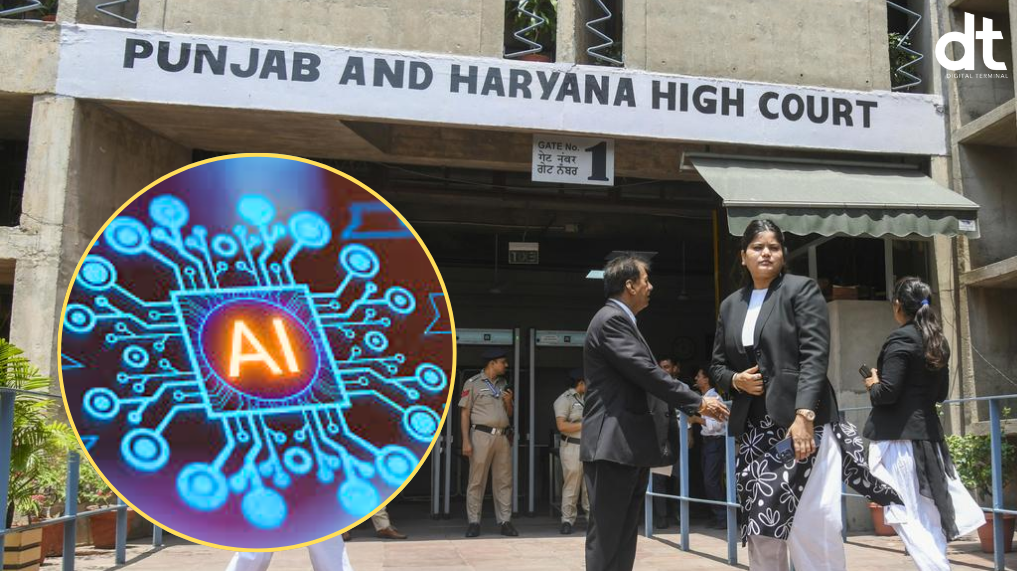

In a significant development reflecting the judiciary’s cautious stance on emerging technologies, the Punjab and Haryana High Court has directed judicial officers under its jurisdiction to refrain from using artificial intelligence tools for drafting judgments or conducting legal research. The directive, issued through an official communication from the Registrar-General, underscores growing institutional concerns around the role of AI in judicial decision-making.
Clear Directive from the Chief Justice
As per media reports, the communication was sent to all district and sessions judges across Punjab, Haryana, and Chandigarh, conveying instructions from the Chief Justice to strictly prohibit the use of AI platforms in judicial functions. The order explicitly names widely used tools such as ChatGPT, Gemini, GitHub Copilot, and other similar platforms.
Judicial officers have been instructed not to rely on these technologies for writing judgments or undertaking legal research. The communication also makes it clear that any violation of these instructions will be treated seriously, indicating a strict enforcement approach.
Rising Judicial Scrutiny of AI in Legal Processes
This move comes amid a broader national conversation on the role of artificial intelligence in the legal ecosystem. Courts are increasingly evaluating both the potential and risks associated with AI-driven tools, particularly in areas that demand high levels of accuracy, accountability, and human judgment.
Concerns around AI-generated content often include issues such as factual inaccuracies, lack of contextual understanding, data privacy risks, and the absence of judicial accountability. In the context of legal proceedings, even minor inaccuracies can have far-reaching implications, making reliance on unverified AI outputs a significant risk.
Gujarat High Court Sets Earlier Precedent
The latest directive aligns with a similar stance taken recently by the Gujarat High Court, which introduced a policy restricting the use of AI in core judicial functions. As per its guidelines, AI tools are not to be used for decision-making, judicial reasoning, drafting orders, preparing judgments, or even in bail and sentencing considerations.
However, the Gujarat High Court’s policy also highlighted a balanced perspective, stating that artificial intelligence could still play a supportive role in enhancing the speed and efficiency of justice delivery, provided it does not replace human reasoning.
Balancing Innovation with Judicial Integrity
The evolving stance of Indian courts reflects a broader global dilemma: how to integrate advanced technologies like AI into traditional systems without compromising their foundational principles. While AI offers immense potential in streamlining research, documentation, and case management, the judiciary appears firm on preserving the sanctity of human judgment in legal decision-making.
Legal experts suggest that while AI can assist in administrative or peripheral functions, its role in core judicial reasoning must remain limited until robust regulatory frameworks, validation mechanisms, and accountability structures are in place.
A Defining Moment for AI in India’s Legal Landscape
The directive from the Punjab and Haryana High Court marks another important step in defining the boundaries of AI adoption within India’s judicial system. As courts continue to grapple with the implications of rapid technological advancement, such measures highlight a clear priority: ensuring that innovation does not come at the cost of justice, accuracy, and institutional trust.
Going forward, the legal fraternity is expected to engage more deeply with questions around AI governance, ethical usage, and the development of court-approved technological frameworks that can safely augment, rather than replace, human expertise.
𝐒𝐭𝐚𝐲 𝐢𝐧𝐟𝐨𝐫𝐦𝐞𝐝 𝐰𝐢𝐭𝐡 𝐨𝐮𝐫 𝐥𝐚𝐭𝐞𝐬𝐭 𝐮𝐩𝐝𝐚𝐭𝐞𝐬 𝐛𝐲 𝐣𝐨𝐢𝐧𝐢𝐧𝐠 𝐭𝐡𝐞 WhatsApp Channel now! 👈📲
𝑭𝒐𝒍𝒍𝒐𝒘 𝑶𝒖𝒓 𝑺𝒐𝒄𝒊𝒂𝒍 𝑴𝒆𝒅𝒊𝒂 𝑷𝒂𝒈𝒆𝐬 👉 Facebook, LinkedIn, Twitter, Instagram
