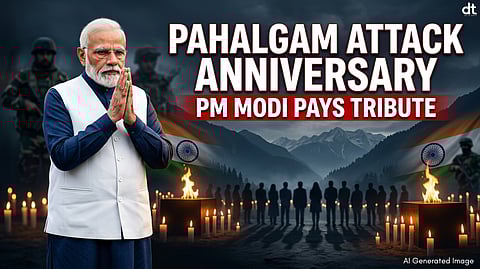

One year after the deadly terror attack in Pahalgam that claimed the lives of 26 innocent civilians, India on Wednesday paused to remember the victims, honour their families, and reaffirm its uncompromising stance against terrorism.
The attack, carried out on April 22, 2025, in one of Jammu and Kashmir’s most visited tourist destinations, sent shockwaves across the country and drew strong condemnation from governments and leaders worldwide. Most of those killed were tourists from different parts of India, making the tragedy not only a security challenge but also a deeply emotional national moment.
As the nation marks the first anniversary of the tragedy, the memory of those who lost their lives remains strong. The incident not only caused grief across India but also became a turning point in the country’s counter-terror doctrine, leading to major military operations and intensified security measures.
The Pahalgam Attack That Shook the Nation
Pahalgam, known for its scenic beauty and popularity among tourists, pilgrims, and families, became the site of horror when terrorists opened fire on civilians last year. The victims reportedly included visitors from multiple Indian states, making the tragedy national in scale.
The attack was seen as a deliberate attempt to damage confidence in Jammu and Kashmir’s improving tourism sector and disturb normalcy returning to the Union Territory.
At the time, Kashmir had witnessed a strong rebound in tourism, rising investments, and increasing public participation in development initiatives. Analysts believed the attack was aimed at undermining that progress.

National Reaction Immediate and Unified
The killings sparked anger and mourning across the country. Citizens, political leaders, industry groups, and civil society organisations condemned the massacre.
Indian Army Issues Stern Warning
The Indian Army marked the anniversary with a strong message, stating that for acts against India, the response is assured and justice will always be served.
The statement carried symbolic significance, particularly in the context of the military actions that followed the 2025 attack.
Prime Minister Modi: India Will Never Bow to Terror
Prime Minister Narendra Modi paid tribute to those who lost their lives and reiterated India’s determination to defeat terrorism in all forms. In his post on X, he said, “Remembering the innocent lives lost in the gruesome Pahalgam terror attack on this day last year. They will never be forgotten. My thoughts are also with the bereaved families as they cope with this loss. As a nation, we stand united in grief and resolve. India will never bow to any form of terror. The heinous designs of terrorists will never succeed.”
His remarks reflected the broader national sentiment that the anniversary is not only a day of mourning, but also a reminder of India’s sharpened security doctrine.
Home Minister Amit Shah Reaffirms Zero Tolerance Policy
Union Home Minister Amit Shah said the pain of losing innocent citizens still remains in the heart of every Indian. He stated on X, “On this day, we solemnly remember the innocent lives we lost in the horrific Pahalgam terror attack last year. The grief and pain of losing our people still remain in the heart of every Indian. Terrorism is the greatest enemy of humanity, against which we must stand united to fight and defeat. India will continue its zero-tolerance policy against terrorism and those who harbour it.”
Rajnath Singh: India’s Response Is Firm and Decisive
Defence Minister Rajnath Singh said the nation would never forget the wounds inflicted by the cowardly attack. He said via X, “Remembering and paying my heartfelt tributes to the innocent people who lost their lives in the cowardly terror attack at Pahalgam in Jammu and Kashmir on 22 April 2025. We share the enduring pain of their loved ones and families. We will never forget those wounds inflicted on our nation.”
He further added, “India has endured decades of cross-border terror, but today our response is firm, decisive and unwavering. Through determined action, we have demonstrated that any attempt to harm our people or disrupt our unity will be met with strength and clarity.”
Jaishankar and Other Ministers Join National Tribute
External Affairs Minister S. Jaishankar joined the nation in remembering the victims and reiterated India’s steadfast resolve to counter terrorism in all its forms. He commented, “Join the nation in remembering the victims of the dastardly Pahalgam terror attack, which took place this day last year. India stands steadfast in its resolve to counter terrorism in all its forms and manifestations.”
Operation Sindoor: India’s Retaliatory Strike
Following the Pahalgam attack, India launched Operation Sindoor during the night of May 6 and 7 last year, described officially as a punitive and precision-led campaign targeting terror infrastructure across the Line of Control and deeper inside Pakistan.
According to official accounts, nine terror-linked camps in Pakistan and Pakistan-occupied territories were struck in coordinated operations involving multiple branches of the armed forces. Indian authorities stated that the strikes were designed to inflict maximum damage on terrorist infrastructure while minimizing civilian harm.
Security analysts viewed the operation as a demonstration of India’s growing capability for integrated land, air, and maritime responses, enabled by years of defence modernization and strategic preparedness.
Highlights of Operation Sindoor
Targets Hit: 9 terror camps and launch infrastructure sites
Locations: Pakistan and Pakistan Occupied Jammu and Kashmir
Groups Targeted: Jaish-e-Mohammed, Lashkar-e-Taiba, Hizbul Mujahideen
Reported Outcome: More than 100 terrorists, trainers, handlers, and associates neutralised
Execution: Coordinated use of air, land, and surveillance assets
Civilian Harm: Officially described as minimal due to precision targeting
Why Operation Sindoor Was Significant
Operation Sindoor was viewed as more than retaliation. It signaled India’s capability to:
Conduct deep precision strikes based on actionable intelligence
Integrate Army, Air Force, and other strategic assets in one mission
Respond rapidly after terror incidents
Impose costs on cross-border terror networks without prolonged escalation
Security experts described it as a landmark demonstration of modern
Operation Mahadev: Hunt for the Attackers
Separately, Operation Mahadev was launched to track down those directly involved in the Pahalgam killings. Officials later stated that after an extended intelligence-led pursuit, three suspected terrorists linked to the attack were neutralised on July 28, 2025. The operation was widely projected as an example of sustained counter-terror coordination and persistence.
International Solidarity
Among the global voices marking the anniversary was Reuven Azar, who said Israel remembers the tragic loss of 26 innocent lives and stands with India in the fight against terror. The message underscored the continuing international support India received after the attack and on its first anniversary.
A Day of Memory and Message
One year later, the wounds of Pahalgam remain fresh for the families who lost loved ones and for a nation that watched a peaceful tourist destination become the scene of tragedy.
Yet the anniversary also highlighted a second narrative, one of national resilience, strategic response, and a clear political consensus that terrorism will be confronted firmly.
As India remembers the 26 lives lost, the message from the country’s leadership and institutions is unmistakable: grief endures, memory remains, and the resolve against terror stands stronger than ever.
𝐒𝐭𝐚𝐲 𝐢𝐧𝐟𝐨𝐫𝐦𝐞𝐝 𝐰𝐢𝐭𝐡 𝐨𝐮𝐫 𝐥𝐚𝐭𝐞𝐬𝐭 𝐮𝐩𝐝𝐚𝐭𝐞𝐬 𝐛𝐲 𝐣𝐨𝐢𝐧𝐢𝐧𝐠 𝐭𝐡𝐞 WhatsApp Channel now! 👈📲
𝑭𝒐𝒍𝒍𝒐𝒘 𝑶𝒖𝒓 𝑺𝒐𝒄𝒊𝒂𝒍 𝑴𝒆𝒅𝒊𝒂 𝑷𝒂𝒈𝒆𝐬 👉 Facebook, LinkedIn, Twitter, Instagram
