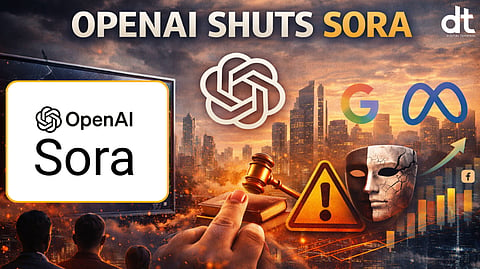

OpenAI has decided to shut down its advanced text-to-video platform Sora. Once hailed as a breakthrough in generative AI, Sora demonstrated the ability to create hyper-realistic videos from simple prompts, capturing global attention from creators, enterprises, and technologists alike.
The move signals more than just the discontinuation of a product. It reflects a deeper strategic recalibration as AI companies navigate rising costs, regulatory scrutiny, and intensifying competition.
The Promise and Power of Sora
Sora represented a new frontier in AI-driven creativity. It enabled users to generate cinematic scenes, detailed environments, and narrative-driven visuals without traditional production infrastructure. This positioned it as a disruptive force across industries such as filmmaking, advertising, gaming, and education.
Its capabilities hinted at a future where content creation could become faster, more accessible, and significantly more scalable. However, such transformative potential also brought complex challenges.
Mounting Challenges: Cost, Control, and Complexity
One of the biggest hurdles in scaling platforms like Sora is the immense computational cost. Video generation models require significantly more processing power and data compared to text or image models, making them expensive to operate at scale.
Equally critical are concerns around misuse. AI-generated video raises serious risks related to deepfakes, misinformation, and intellectual property violations. Ensuring content authenticity and implementing robust safeguards has proven to be both technically and operationally demanding.
Regulatory pressures are also increasing globally, with governments and policymakers pushing for stricter oversight of generative AI technologies. This adds another layer of complexity for companies deploying advanced media generation tools.
Intensifying Competition in AI Video Innovation
The generative video space has quickly become crowded, with major players investing aggressively. Companies like Google and Meta are advancing their own AI video models, while startups continue to innovate rapidly in niche segments.
This competitive pressure likely influenced OpenAI’s decision to focus on areas where it holds stronger market leadership, such as conversational AI and enterprise-grade solutions.
Strategic Refocus on Core Strengths
The shutdown of Sora appears to be part of OpenAI’s broader effort to streamline its portfolio and prioritize scalable, revenue-generating technologies. The company continues to invest heavily in its flagship AI models, APIs, and enterprise offerings, which have seen widespread adoption across industries.
By reallocating resources, OpenAI aims to strengthen its position in high-demand segments while ensuring sustainable growth and compliance with evolving regulations.
What This Means for the Industry
Sora’s discontinuation highlights a critical turning point in the AI industry. The focus is shifting from rapid experimentation to responsible innovation, scalability, and real-world application. Companies are increasingly being evaluated not just on technological breakthroughs but on their ability to deploy AI safely and sustainably.
The Road Ahead for Generative Video
While Sora may be exiting the stage, the broader vision of AI-powered video generation remains very much alive. The technology is expected to evolve, with improvements in efficiency, governance, and ethical frameworks.
In the long run, Sora’s legacy will serve as both an inspiration and a lesson. It demonstrated what is technologically possible while also underscoring the challenges of bringing such powerful tools to market responsibly.
As the AI ecosystem matures, decisions like this reinforce a clear reality: innovation alone is not enough. Sustainability, trust, and strategic focus are now equally critical in shaping the future of artificial intelligence.
𝐒𝐭𝐚𝐲 𝐢𝐧𝐟𝐨𝐫𝐦𝐞𝐝 𝐰𝐢𝐭𝐡 𝐨𝐮𝐫 𝐥𝐚𝐭𝐞𝐬𝐭 𝐮𝐩𝐝𝐚𝐭𝐞𝐬 𝐛𝐲 𝐣𝐨𝐢𝐧𝐢𝐧𝐠 𝐭𝐡𝐞 WhatsApp Channel now! 👈📲
𝑭𝒐𝒍𝒍𝒐𝒘 𝑶𝒖𝒓 𝑺𝒐𝒄𝒊𝒂𝒍 𝑴𝒆𝒅𝒊𝒂 𝑷𝒂𝒈𝒆𝐬 👉 Facebook, LinkedIn, Twitter, Instagram

