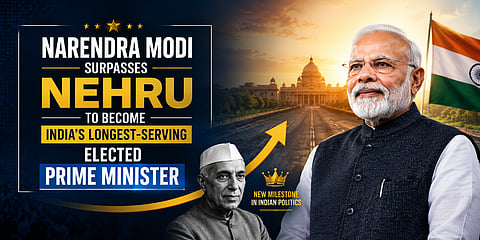

Prime Minister Narendra Modi has entered the record books by becoming India's longest-serving elected Prime Minister, completing 4,399 consecutive days in office on June 10, 2026. The milestone places him ahead of India's first Prime Minister, Jawaharlal Nehru, who served 4,398 uninterrupted days following victories in the nation's first three general elections.
The achievement represents a significant moment in India's political history, highlighting the sustained electoral success of Modi and the Bharatiya Janata Party (BJP)-led National Democratic Alliance (NDA) over more than a decade.
From 2014 Victory to Historic Record
Modi first assumed office on May 26, 2014, after leading the BJP to a decisive victory in the general elections. He subsequently secured re-election in 2019 and again in 2024, becoming one of the few Indian leaders to win three consecutive national mandates.
Over the years, his tenure has been associated with major policy initiatives, large-scale infrastructure projects, digital transformation programs, and efforts to position India as a key player in the global economy.
The Prime Minister's political journey from Chief Minister of Gujarat to becoming India's longest-serving elected head of government reflects a remarkable rise in modern Indian politics.
Nehru's Legacy Remains Intact
While Modi has surpassed Nehru's record for the longest uninterrupted tenure achieved through electoral victories, Nehru continues to hold the distinction of being India's longest-serving Prime Minister overall.
Nehru remained in office from India's Independence in 1947 until his death in 1964, overseeing the country's formative years and laying the foundations of many of its democratic institutions, foreign policy frameworks, and economic structures.
As a result, both leaders now occupy distinct places in India's political record books—Nehru as the longest-serving Prime Minister in total duration and Modi as the longest-serving elected Prime Minister through continuous democratic mandates.
A Defining Era in Indian Politics
Modi's tenure has coincided with a period of significant political transformation, during which the BJP expanded its electoral footprint across multiple states and strengthened its position as India's dominant national political force.
His leadership style, communication strategy, and emphasis on governance reforms have helped shape contemporary political discourse. Supporters frequently associate his tenure with the slogan "Modi Hai Toh Mumkin Hai," reflecting the belief that ambitious goals can be achieved under his leadership.
The milestone also underscores the increasing importance of leadership continuity in a country that has witnessed numerous coalition governments and political transitions since Independence.
Looking Ahead
As Modi crosses the historic 4,399-day mark, attention is likely to shift toward the next phase of his government and the broader political landscape ahead of future elections.
Regardless of political perspectives, the achievement represents a notable chapter in India's democratic journey, highlighting the endurance of electoral leadership in the world's largest democracy.
With his name now firmly etched into the country's political history, Modi's record-setting tenure is set to remain a significant reference point for future generations of Indian leaders.
𝐒𝐭𝐚𝐲 𝐢𝐧𝐟𝐨𝐫𝐦𝐞𝐝 𝐰𝐢𝐭𝐡 𝐨𝐮𝐫 𝐥𝐚𝐭𝐞𝐬𝐭 𝐮𝐩𝐝𝐚𝐭𝐞𝐬 𝐛𝐲 𝐣𝐨𝐢𝐧𝐢𝐧𝐠 𝐭𝐡𝐞 WhatsApp Channel now! 👈📲
𝑭𝒐𝒍𝒍𝒐𝒘 𝑶𝒖𝒓 𝑺𝒐𝒄𝒊𝒂𝒍 𝑴𝒆𝒅𝒊𝒂 𝑷𝒂𝒈𝒆𝐬 👉 Facebook, LinkedIn, Twitter, Instagram
