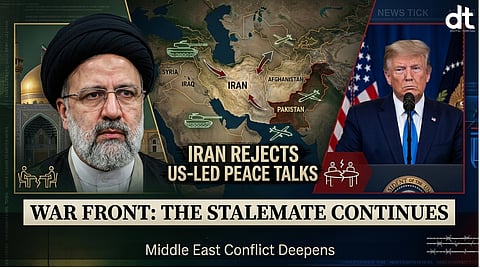

Iran has sharply escalated its diplomatic confrontation with the United States by refusing to participate in a proposed second round of peace talks and declaring that negotiations cannot take place under military pressure or public threats. The move comes as a fragile temporary ceasefire between Washington and Tehran approaches its April 22 deadline, intensifying fears of renewed conflict in one of the world’s most strategically sensitive regions.
Iranian officials have accused Washington of repeatedly changing its demands, violating earlier understandings reached through indirect contacts, and attempting to impose what they described as a surrender framework rather than a fair diplomatic settlement.
Tehran Signals No Retreat
Iran’s latest statements indicate a hardening posture at the highest political levels, with leaders publicly rejecting any talks that appear one-sided or coercive.
Ghalibaf Fires Direct Warning to Trump
Iran’s Parliament Speaker and chief negotiator Mohammad Bagher Ghalibaf issued one of Tehran’s strongest warnings yet, accusing the United States of violating the ceasefire through its actions in the Strait of Hormuz.
In a post on X, Ghalibaf said, “The American siege in the Strait of Hormuz is a violation of the ceasefire. President Trump wants to tilt negotiations in his favor and force Iran to surrender. We want to make it clear that Iran will make no deal under the shadow of threats.”
He also warned that Iran has spent the past two weeks preparing for the next phase of conflict and could reveal “new cards” if provoked further.
President Pezeshkian Says Iran Will Never Surrender
Iranian President Masoud Pezeshkian echoed the same defiant tone, openly questioning America’s credibility and accusing Washington of using a double standard approach.
Posting on X, Pezeshkian said, “The first condition for commitment is to stand by it. Iran did not trust America before, and America’s double approach is making matters worse. The US wants Iran to surrender, but that will never happen.”
Strait of Hormuz Flashpoint Intensifies Crisis
At the center of the latest dispute is the Strait of Hormuz, the strategic maritime passage through which a major share of global oil exports move each day. Tensions rose after US forces reportedly seized an Iranian-flagged vessel near the chokepoint, alleging it attempted to bypass an existing naval blockade. Tehran denounced the move as piracy and a breach of the ceasefire environment.
The renewed friction has rattled global markets. Oil prices surged and regional stock exchanges weakened as traders priced in the risk of a broader military escalation or shipping disruption in the Gulf.
Washington Still Preparing for Talks
Despite Tehran’s refusal, the US side has signaled that its delegation remains prepared for talks in Islamabad. Reports indicate senior American officials were expected to travel for a new diplomatic round, though Iranian attendance remains uncertain.
Former US President Donald Trump, central to current US policy messaging in these reports, reportedly warned that failure to reach an agreement could trigger harsher military action, comments that appear to have further hardened Tehran’s position.
Why This Matters Globally
This confrontation is no longer just a bilateral dispute. If the ceasefire collapses, the fallout could be global:
Oil prices could spike sharply
Shipping insurance costs may surge
Gulf military deployments may expand
Israel, Lebanon, Iraq and Syria could be pulled into wider escalation
Global markets may react violently
What Happens Next?
With the ceasefire clock running down, diplomats across the region including mediators in Pakistan, Turkey and Egypt are under pressure to salvage negotiations. However, the current mood suggests both sides remain far apart on core issues such as sanctions relief, maritime access, security guarantees and military de-escalation.
Unless last-minute diplomacy succeeds, the collapse of talks could push the US-Iran standoff into a more dangerous phase, with consequences not only for the Middle East but also for global energy supply chains and financial markets.
𝐒𝐭𝐚𝐲 𝐢𝐧𝐟𝐨𝐫𝐦𝐞𝐝 𝐰𝐢𝐭𝐡 𝐨𝐮𝐫 𝐥𝐚𝐭𝐞𝐬𝐭 𝐮𝐩𝐝𝐚𝐭𝐞𝐬 𝐛𝐲 𝐣𝐨𝐢𝐧𝐢𝐧𝐠 𝐭𝐡𝐞 WhatsApp Channel now! 👈📲
𝑭𝒐𝒍𝒍𝒐𝒘 𝑶𝒖𝒓 𝑺𝒐𝒄𝒊𝒂𝒍 𝑴𝒆𝒅𝒊𝒂 𝑷𝒂𝒈𝒆𝐬 👉 Facebook, LinkedIn, Twitter, Instagram
