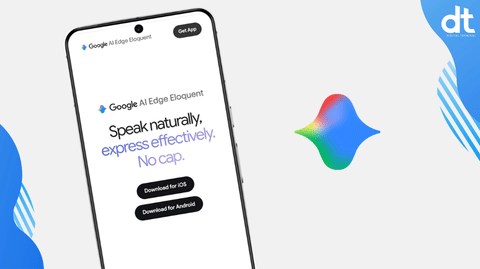

In a subtle yet strategically significant move, Google has stepped into the fast-evolving AI transcription space with the launch of a new iOS app designed to function even without an internet connection. The app, titled Google AI Edge Eloquent, reflects the company’s growing focus on edge AI, where processing happens directly on the device rather than relying entirely on cloud infrastructure.
A Shift Toward Offline-First AI Experiences
Unlike conventional speech-to-text tools that depend heavily on cloud processing, Eloquent is built around an offline-first architecture. Once users download the required AI models, the app can transcribe spoken words locally, ensuring accessibility even in low-connectivity environments. This approach aligns with the broader industry push toward privacy-centric and latency-free AI applications.
At its core, the app leverages advanced speech recognition capabilities powered by Gemma models. These on-device models are designed to interpret natural speech patterns while minimizing processing delays, making real-time dictation smoother and more responsive.
From Raw Speech to Refined Text
What differentiates Eloquent from standard dictation tools is its ability to intelligently refine spoken input. Instead of producing literal transcripts filled with pauses and verbal fillers, the app automatically cleans up the output by removing hesitations and restructuring sentences for clarity.
Users are also given the flexibility to reshape their transcripts using built-in transformation options such as summarizing key points, adjusting tone to formal, or expanding and shortening the content. This positions the app as more than just a transcription tool, evolving it into a lightweight AI writing assistant.
When cloud mode is enabled, Eloquent taps into Google Gemini for more advanced text processing. However, users retain full control to switch to a completely local mode, reinforcing data privacy and reducing reliance on external servers.
Personalized and Context-Aware Dictation
To enhance accuracy, the app supports custom vocabulary inputs, allowing users to add domain-specific terminology, names, or frequently used phrases. It can also optionally draw contextual cues from linked accounts such as Gmail, enabling more precise recognition of personal or professional language patterns.
Beyond transcription, Eloquent introduces productivity-focused features including searchable history, session tracking, and performance insights like speaking speed and total word count. These additions signal a move toward analytics-driven communication tools.
Competitive Landscape and What Comes Next
With this launch, Google enters a competitive space currently occupied by AI-native dictation platforms like Wispr Flow and SuperWhisper. However, its emphasis on offline functionality and deep ecosystem integration could offer a distinct advantage, particularly for users prioritizing privacy and seamless cross-device experiences.
Although the app is currently limited to iOS, references to Android compatibility suggest a broader rollout may be on the horizon. Given Google’s control over the Android ecosystem, deeper integration, potentially at the keyboard or system level, could significantly expand its reach.
A Glimpse Into the Future of Voice Interfaces
The introduction of Eloquent underscores a larger transition in how users interact with devices. As AI models become more efficient and capable of running locally, the boundary between speech and structured content continues to blur.
For Google, this experiment is more than just a standalone app. It represents a testing ground for next-generation voice interfaces that could eventually reshape how users compose emails, draft documents, and communicate across digital platforms.
If successful, the technology behind Eloquent may soon find its way into broader Android experiences, signaling a future where speaking naturally becomes the most efficient way to create polished, professional content.
𝐒𝐭𝐚𝐲 𝐢𝐧𝐟𝐨𝐫𝐦𝐞𝐝 𝐰𝐢𝐭𝐡 𝐨𝐮𝐫 𝐥𝐚𝐭𝐞𝐬𝐭 𝐮𝐩𝐝𝐚𝐭𝐞𝐬 𝐛𝐲 𝐣𝐨𝐢𝐧𝐢𝐧𝐠 𝐭𝐡𝐞 WhatsApp Channel now! 👈📲
𝑭𝒐𝒍𝒍𝒐𝒘 𝑶𝒖𝒓 𝑺𝒐𝒄𝒊𝒂𝒍 𝑴𝒆𝒅𝒊𝒂 𝑷𝒂𝒈𝒆𝐬 👉 Facebook, LinkedIn, Twitter, Instagram
