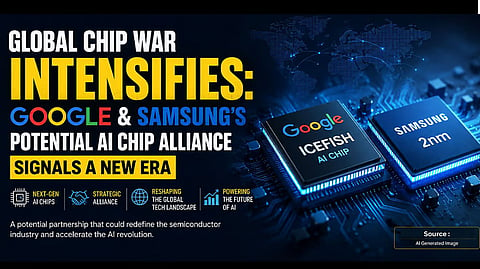

Google and Samsung are reportedly in advanced talks to collaborate on Google's next-generation AI chip, codenamed Icefish. Here's why this potential partnership could reshape the global semiconductor and AI landscape.
The global artificial intelligence race is entering a new phase, and this time the battle is not just about AI models or chatbots—it's about the chips powering them.
According to recent reports, Google is in discussions with Samsung Electronics to manufacture a critical component of its next-generation AI processor, internally known as "Icefish." While the companies have not officially confirmed a final agreement, industry sources suggest the talks are serious enough to attract global attention across the semiconductor ecosystem.
At first glance, this may seem like another business deal between two tech giants. However, industry experts believe it reflects a much larger shift taking place in the global AI and semiconductor markets.
Why Icefish Matters
Google has been aggressively investing in its proprietary Tensor Processing Units (TPUs)—specialized chips designed to train and run artificial intelligence models. These chips have become increasingly important for Google's cloud business and AI services as the company seeks alternatives to the dominance of Nvidia's GPUs.
The upcoming Icefish processor is reportedly Google's tenth-generation TPU and is being developed in partnership with chip design company MediaTek. Reports indicate that the chip could enter mass production as early as 2028.
Under the current plan, the most computationally intensive portion of the chip is expected to be manufactured by TSMC, the world's leading advanced chipmaker. Samsung, meanwhile, may produce the memory-interface component using its advanced 2-nanometer manufacturing technology.
This division of responsibilities highlights a growing trend among technology companies: reducing dependence on a single supplier.
The Real Story: Diversification
For years, TSMC has dominated advanced semiconductor manufacturing. The explosion of AI demand, largely driven by companies building large language models and AI infrastructure, has placed enormous pressure on global chip production capacity.
As demand continues to surge, many technology firms are looking for additional manufacturing partners to avoid supply-chain bottlenecks.
Google's reported discussions with Samsung appear to fit into that broader strategy. The company is said to be exploring multiple manufacturing relationships, including reported conversations with Intel regarding future TPU production.
For Google, diversification could provide greater flexibility, improved production capacity, and reduced operational risk in an increasingly competitive AI market.
A Major Opportunity for Samsung
The potential partnership could be equally significant for Samsung. Although Samsung remains one of the world's largest technology companies, its foundry business has struggled to match TSMC's dominance in advanced chip manufacturing. Winning a role in Google's next-generation AI processor would serve as a powerful endorsement of Samsung's 2-nanometer technology capabilities.
Industry analysts view AI chip manufacturing as one of the most valuable growth opportunities of the decade. Every major AI platform—from cloud services to autonomous systems—depends on increasingly powerful semiconductor infrastructure. Landing a high-profile customer such as Google could help Samsung attract additional AI-focused clients and strengthen its position in the global foundry market.
The Bigger Picture: The AI Infrastructure Race
The discussions between Google and Samsung underscore a reality that is becoming clearer every day: the future of AI will be determined as much by hardware as by software.While consumers often focus on AI assistants, image generators, and chatbots, the companies building the underlying semiconductor infrastructure are quietly shaping the next generation of technology. Governments, cloud providers, semiconductor manufacturers, and AI companies are all investing billions of dollars to secure access to advanced chips. The result is a global competition that many industry observers now describe as a modern "chip war."
In this environment, partnerships matter. Manufacturing capacity matters. Supply chains matter. And perhaps most importantly, access to advanced semiconductor technology has become a strategic advantage rather than just a technical requirement.
What Happens Next?
At this stage, the reported Google-Samsung discussions remain under development, and neither company has publicly announced a finalized agreement. However, the fact that such talks are taking place highlights the growing urgency among technology leaders to secure future AI chip capacity.
If the partnership moves forward, it could become one of the most important semiconductor collaborations of the decade—strengthening Google's AI ambitions while giving Samsung a valuable foothold in the next generation of AI infrastructure. One thing is certain: as the AI revolution accelerates, the race for advanced chips is becoming just as important as the race for advanced algorithms. And in that battle, every alliance counts.
𝐒𝐭𝐚𝐲 𝐢𝐧𝐟𝐨𝐫𝐦𝐞𝐝 𝐰𝐢𝐭𝐡 𝐨𝐮𝐫 𝐥𝐚𝐭𝐞𝐬𝐭 𝐮𝐩𝐝𝐚𝐭𝐞𝐬 𝐛𝐲 𝐣𝐨𝐢𝐧𝐢𝐧𝐠 𝐭𝐡𝐞 WhatsApp Channel now! 👈📲
𝑭𝒐𝒍𝒍𝒐𝒘 𝑶𝒖𝒓 𝑺𝒐𝒄𝒊𝒂𝒍 𝑴𝒆𝒅𝒊𝒂 𝑷𝒂𝒈𝒆𝐬 👉 Facebook, LinkedIn, Twitter, Instagram
