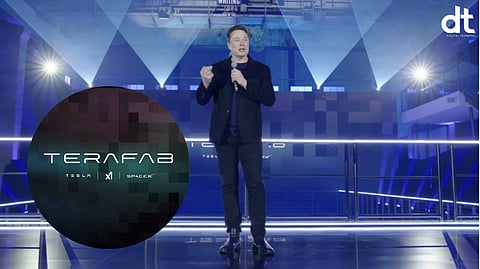

Elon Musk is once again pushing the boundaries of technology with a bold new move into semiconductor manufacturing. The Tesla CEO has unveiled plans for an ambitious project named Terafab, a next-generation chip fabrication facility proposed to be built in Austin, Texas.
According to reports, the project is expected to be jointly driven by Tesla, SpaceX, and supported by Musk’s AI venture xAI, marking one of the most integrated approaches to chip development ever envisioned by a single technology ecosystem.
During a recent event in downtown Austin, Musk emphasized the urgency behind the initiative, highlighting that the global semiconductor industry is not evolving fast enough to meet the explosive demand from emerging technologies such as AI, robotics, and autonomous systems.
The statement reflects Musk’s long-standing concern about supply chain constraints and his belief that control over chip production is critical for scaling advanced technologies across Tesla’s electric vehicles, autonomous driving systems, humanoid robots, and SpaceX’s aerospace ambitions.

What the Terafab Facility Aims to Achieve
The proposed Terafab facility is expected to begin as an advanced technology fab, capable of both producing and testing a wide range of semiconductor chips. While detailed technical specifications are still under wraps, the project is being positioned as a highly flexible and innovation-driven manufacturing hub.
Industry observers suggest that the facility could play a pivotal role in developing specialized chips tailored for AI workloads, high-performance computing, and real-time decision systems, which are essential for Musk’s growing portfolio of companies.
A Unified Ecosystem Across Tesla, SpaceX, and xAI
One of the most notable aspects of the Terafab project is its cross-company collaboration. By aligning Tesla, SpaceX, and xAI under a shared semiconductor vision, Musk appears to be aiming for deep vertical integration.
Tesla could leverage custom chips for autonomous driving and robotics
SpaceX may benefit from advanced computing for satellite systems and space exploration
xAI is likely to utilize cutting-edge processors to accelerate AI model training and deployment
This ecosystem approach may reduce dependency on external chip suppliers and allow tighter optimization between hardware and software across Musk-led ventures.
Industry Context and Competitive Landscape
The global semiconductor industry has been under pressure due to rising demand and geopolitical supply chain concerns. Major players such as Intel Corporation, Taiwan Semiconductor Manufacturing Company (TSMC), and Samsung Electronics currently dominate advanced chip manufacturing.
If realized, the Terafab project could position Musk as a disruptive force in a highly specialized and capital-intensive industry that typically requires decades of expertise and massive infrastructure investment.
Strategic Implications for the Future
While details about timelines, investment size, and production capacity remain limited, the announcement itself signals a long-term strategic play rather than a short-term venture.
The Terafab initiative aligns with Musk’s broader vision of accelerating the future of AI-driven technologies. By attempting to secure chip supply internally, Musk is essentially addressing one of the biggest bottlenecks in modern innovation: semiconductor availability.
Outlook
The Terafab project is still in its early conceptual phase, and further updates are expected as plans progress. However, if executed successfully, it could reshape how technology companies approach chip manufacturing and vertical integration in the AI era.
For now, Musk’s vision reinforces a clear message: the future of AI, robotics, and autonomous systems will be powered not just by software innovation, but by control over the silicon that runs it.
𝐒𝐭𝐚𝐲 𝐢𝐧𝐟𝐨𝐫𝐦𝐞𝐝 𝐰𝐢𝐭𝐡 𝐨𝐮𝐫 𝐥𝐚𝐭𝐞𝐬𝐭 𝐮𝐩𝐝𝐚𝐭𝐞𝐬 𝐛𝐲 𝐣𝐨𝐢𝐧𝐢𝐧𝐠 𝐭𝐡𝐞 WhatsApp Channel now! 👈📲
𝑭𝒐𝒍𝒍𝒐𝒘 𝑶𝒖𝒓 𝑺𝒐𝒄𝒊𝒂𝒍 𝑴𝒆𝒅𝒊𝒂 𝑷𝒂𝒈𝒆𝐬 👉 Facebook, LinkedIn, Twitter, Instagram
