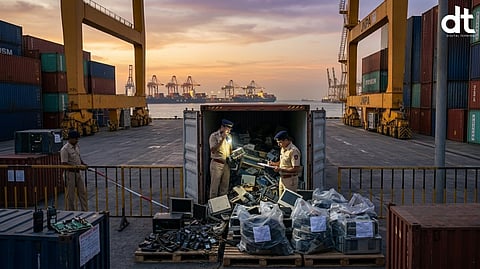

A significant enforcement action by the Directorate of Revenue Intelligence (DRI) has exposed a large-scale case of suspected import violations at Nhava Sheva Port, where officials intercepted a shipment carrying prohibited communication equipment and restricted electronic waste concealed within declared goods.
According to some media reports, DRI officers carried out a coordinated inspection of eight containers that had arrived from China after credible intelligence inputs. The search led to the discovery of over 11,000 banned walkie-talkie units along with a substantial quantity of second-hand hard disk drives (HDDs), both of which are tightly regulated under Indian import norms.
Misdeclaration Used to Mask Restricted Imports
Preliminary findings suggest that the illegal items were deliberately hidden among a broader consignment of electronic goods, collectively valued at approximately ₹30.25 crore. Of this, the restricted and prohibited components alone were estimated at around ₹9.25 crore, while the remaining goods were declared at about ₹21 crore.
Officials believe this layering of goods was an attempt to evade regulatory scrutiny and bypass customs checks by disguising the true nature of the shipment. The case has been booked under provisions of the Customs Act for misdeclaration and violation of import regulations.
Banned Communication Devices Raise Security Concerns
Among the seized items were Baofeng BF-888S walkie-talkies, valued at nearly ₹2.5 crore. These devices have been blacklisted by the Department of Telecommunications (DoT) as they operate on frequencies not permitted for unlicensed use in India.
Authorities emphasized that such communication devices can pose serious risks if used without authorization, as they may enable unregulated or covert communication channels. Their import and usage require prior licensing, which was not obtained in this instance.
Restricted E-Waste and Regulatory Violations
In addition to the communication equipment, the consignment also included second-hand HDDs worth ₹6.75 crore. These items fall under the category of electronic waste and are subject to strict import controls.
The Directorate General of Foreign Trade (DGFT) mandates prior approval for importing such goods, which was absent in this case. Officials noted that improper handling or import of e-waste not only violates trade rules but can also pose environmental and data security risks.
Arrests and Ongoing Investigation
The available reports in the media says that the father-son duo, who are believed to be the proprietors of the Mumbai-based firms linked to the shipment, have been arrested. Authorities allege that the firms were responsible for importing the goods without securing the necessary permissions and regulatory clearances.
Investigators are now probing deeper to trace the broader supply chain, assess whether similar consignments have been imported previously, and determine the end-use of the seized equipment. The scale of the seizure suggests the possibility of a wider network operating across multiple transactions.
Enforcement Drive Against Illicit Trade
Officials described the operation as part of a sustained effort to clamp down on illegal imports that undermine both economic stability and national security. The action reflects increased vigilance by enforcement agencies to ensure compliance with customs laws and to prevent misuse of restricted technologies.

Industry Perspective Highlights Broader Implications
Sharing his perspective on the development, Sameer Bhatia, Senior Regional Director for India, Middle East, Turkey and Africa at Seagate Technology, and a seasoned leader in the IT storage domain, highlighted the wider significance of the enforcement action. He noted, "The recent DRI action at Nhava Sheva is an important reminder that illegal imports are not just a trade or pricing issue — they are a national security concern. The seizure of prohibited communication devices, along with second-hand HDDs, points to a broader pattern of misdeclaration and systemic violations. These importers have imported huge in last 2 years but not anymore. Appreciation to DRI, Customs, Dot, Meity, DGFT and CBIC for their decisive and timely action in safeguarding India’s communication and data ecosystem.”
He further added, “It also sends a clear signal to the market — business practices such as importing and selling under private labels do not provide immunity from regulatory scrutiny and they can’t put nation and its citizens at risk. As India continues to scale its AI, data centre, and surveillance infrastructure, the integrity of underlying hardware becomes critical. Compromised or unverified components are not just a technical risk — they have wider implications for data security and trust. Strong confidence in our government and enforcement agencies as they continue to take the right steps in this direction.”
A Growing Focus on Compliance and Hardware Integrity
The Nhava Sheva seizure underscores a broader shift toward stricter enforcement in India’s trade ecosystem, particularly in sectors involving sensitive technologies and data-related hardware. As regulatory scrutiny intensifies, importers and distributors are expected to adhere more closely to compliance norms, ensuring transparency in sourcing and classification of goods.
The case serves as a reminder that violations in import practices can trigger not only financial penalties but also serious legal consequences, while reinforcing the importance of maintaining integrity across the supply chain in an increasingly technology-driven economy.
𝐒𝐭𝐚𝐲 𝐢𝐧𝐟𝐨𝐫𝐦𝐞𝐝 𝐰𝐢𝐭𝐡 𝐨𝐮𝐫 𝐥𝐚𝐭𝐞𝐬𝐭 𝐮𝐩𝐝𝐚𝐭𝐞𝐬 𝐛𝐲 𝐣𝐨𝐢𝐧𝐢𝐧𝐠 𝐭𝐡𝐞 WhatsApp Channel now! 👈📲
𝑭𝒐𝒍𝒍𝒐𝒘 𝑶𝒖𝒓 𝑺𝒐𝒄𝒊𝒂𝒍 𝑴𝒆𝒅𝒊𝒂 𝑷𝒂𝒈𝒆𝐬 👉 Facebook, LinkedIn, Twitter, Instagram
