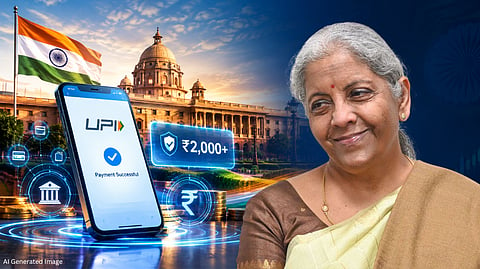

The government has opened the door for merchant discount rate (MDR) charges on higher-value UPI transactions, while ensuring that payments of up to ₹2,000 remain free of charges.
The Finance Ministry, through a gazette notification dated September 14, specified UPI transactions up to ₹2,000 and RuPay-powered debit card payments as electronic payment modes on which banks and system providers cannot impose any direct or indirect charge.
The move marks a change from the earlier blanket restriction on charges across UPI transactions. Following amendments to the Payment and Settlement Systems Act, 2007, the government now has the power to specify the electronic payment modes and transaction categories that will remain exempt from charges.
Higher-Value UPI Payments in Focus
While the notification protects UPI payments up to ₹2,000, it does not itself introduce a specific MDR rate for transactions above the threshold.
The next step will be the development of the framework for higher-value payments. The UPI and Services Steering Committee, headed by the National Payments Corporation of India (NPCI), is expected to work on the structure and rates for any future MDR.
Reports had earlier suggested that UPI payments above ₹2,000 could attract an MDR of around 40 basis points, or 0.4%. However, the rate and revenue-sharing structure have not been formally finalised through the latest notification.
UPI’s Growing Scale Drives Monetisation Debate
The timing of the move is significant as UPI continues to expand at a massive scale. NPCI data shows that UPI processed 24.51 billion transactions worth ₹29.82 lakh crore in August 2026, marking a record monthly transaction volume.
Since the introduction of the zero-MDR regime in 2020, UPI has become central to India’s digital payments ecosystem. However, banks, payment service providers and other participants have continued to face the cost of maintaining and processing the rapidly growing transaction volumes.
A potential MDR framework could therefore create a direct revenue stream for participants across the UPI ecosystem while changing the economics of higher-value merchant payments.
Small Payments Remain Free
For consumers and businesses handling everyday low-value transactions, the immediate impact is limited. UPI payments up to ₹2,000 will remain protected from charges under the new notification.
The bigger question now is how the government and NPCI structure charges for higher-value transactions. The final MDR framework will determine whether and how banks, third-party application providers and acquiring banks share revenue from these payments.
For India’s digital payments industry, the notification marks an important shift from a completely zero-MDR model towards a possible differentiated approach, where small-value UPI payments remain free while higher-value transactions could become a source of revenue for the ecosystem.
𝐒𝐭𝐚𝐲 𝐢𝐧𝐟𝐨𝐫𝐦𝐞𝐝 𝐰𝐢𝐭𝐡 𝐨𝐮𝐫 𝐥𝐚𝐭𝐞𝐬𝐭 𝐮𝐩𝐝𝐚𝐭𝐞𝐬 𝐛𝐲 𝐣𝐨𝐢𝐧𝐢𝐧𝐠 𝐭𝐡𝐞 WhatsApp Channel now! 👈📲
𝑭𝒐𝒍𝒍𝒐𝒘 𝑶𝒖𝒓 𝑺𝒐𝒄𝒊𝒂𝒍 𝑴𝒆𝒅𝒊𝒂 𝑷𝒂𝒈𝒆𝐬 👉 Facebook, LinkedIn, Twitter, Instagram
