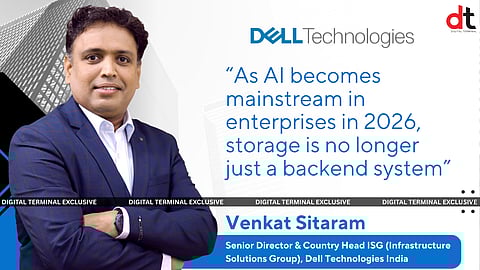

As artificial intelligence becomes deeply embedded into enterprise operations, storage is undergoing a profound shift in its role and relevance. No longer limited to backend infrastructure, storage is now emerging as a strategic enabler of AI innovation, cyber resilience, and modern private cloud environments. In an exclusive interaction with Digital Terminal, Venkat Sitaram, Senior Director & Country Head ISG (Infrastructure Solutions Group), Dell Technologies India, explains how enterprise storage strategies are evolving as AI moves firmly into the mainstream in 2026.
Storage Evolves into the Foundation of AI Innovation
Highlighting a fundamental shift in enterprise thinking, Venkat emphasized that storage is no longer a passive component of IT infrastructure. “As AI becomes mainstream in enterprises in 2026, storage is no longer just a backend system. It is becoming the foundation of AI innovation, secure data use and modern private cloud strategies,” he said.
He further explained that the success of digital transformation initiatives increasingly depends on data readiness. “The next phase of digital transformation will depend not only on faster computing, but on how well organizations manage, protect and use their data at scale,” Venkat added.
One of the most notable changes shaping storage strategies is the move toward data-centric AI infrastructure. “One of the biggest changes we are seeing is the shift toward data-centric AI infrastructure. AI workloads are very different from traditional applications. They need high speed, low latency and the ability to handle large volumes of structured and unstructured data. This is pushing enterprises to adopt purpose-built storage platforms that work seamlessly with virtualized, containerized and cloud environments,” Venkat explained.
Disaggregated Private Clouds Gain Momentum
Venkat highlighted the growing adoption of disaggregated private cloud architectures as another major trend. “Another important trend is the growing adoption of disaggregated private clouds. Many CIOs want to avoid vendor lock-in, rising costs and rigid systems. Modern private clouds use software-defined storage, flexible cloud platforms and automation to give organizations more control over where data lives and how it is managed,” he said.
He further noted the role of automation in simplifying cloud operations. “Automation platforms make it easier to deploy, scale and manage private clouds while maintaining security and performance,” Venkat added, underlining the need for agility in AI-driven enterprises.
Efficiency and Sustainability Drive Storage Decisions
With AI generating unprecedented volumes of data, storage efficiency has become a critical consideration. Storage efficiency has also become critical. AI is creating massive amounts of data, and enterprises must manage this growth without increasing costs or energy use at the same pace,” Venkat said.
He highlighted emerging technologies that help organizations balance performance with efficiency. “Technologies such as high-density flash storage and intelligent data placement help organizations store more data in less space, reduce power consumption and improve overall efficiency,” he explained, stressing the dual benefits of cost optimization and sustainability.
Cyber Resilience and Data Sovereignty Take Center Stage
Security is now inseparable from storage strategy, particularly as AI becomes deeply integrated into business operations. “Security and cyber resilience are now core parts of storage strategy. As AI becomes more deeply connected to business operations, the impact of data loss or cyberattacks increases,” Venkat warned.
Modern storage systems are therefore built with built-in resilience. “Modern storage systems are built with security features such as anomaly detection, immutable backups and automated recovery,” he said. “This helps organizations detect threats early and recover quickly when issues occur.”
Venkat also highlighted the importance of data sovereignty. “This helps organizations detect threats early and recover quickly when issues occur. Data sovereignty is another growing consideration. Enterprises must align their storage strategies while still supporting innovation,” he added, emphasizing the balance between regulatory compliance and operational flexibility.
Reimagining Storage as a Strategic Asset
Looking ahead, Venkat believes CIOs must treat storage as a strategic business asset rather than a supporting infrastructure component. “To support the next stage of digital transformation, CIOs need to rethink storage as a strategic asset,” he said.
He emphasized that future-ready storage platforms must support both traditional workloads and modern AI-driven applications. “Storage platforms must support both traditional workloads, such as core databases, and modern workloads, including AI and cloud-native applications. A unified storage approach helps simplify operations while delivering performance and reliability,” Venkat explained.
Automation, he noted, will play a decisive role. “Automation will be essential. Managing infrastructure manually is no longer practical in AI-driven environments. Intelligent monitoring and self-healing systems reduce downtime, simplify operations and allow IT teams to focus on higher-value work,” he said.
A robust data management layer is equally critical. “Finally, organizations need a strong data management layer. In the AI-driven future, data is constantly being used to generate real-time insights. Enterprises need platforms that can bring data together from different sources, keep it secure and make it easily available for AI applications,” Venkat added.
Building Strong Foundations for AI Success
Summing up, Venkat emphasized that long-term success in an AI-first world will depend on building strong, secure, and efficient data foundations. “Looking ahead, success will come from building strong, efficient and secure data foundations. Enterprises that treat storage as the backbone of AI innovation will be better prepared to turn AI investments into real business outcomes,” he concluded.
𝐒𝐭𝐚𝐲 𝐢𝐧𝐟𝐨𝐫𝐦𝐞𝐝 𝐰𝐢𝐭𝐡 𝐨𝐮𝐫 𝐥𝐚𝐭𝐞𝐬𝐭 𝐮𝐩𝐝𝐚𝐭𝐞𝐬 𝐛𝐲 𝐣𝐨𝐢𝐧𝐢𝐧𝐠 𝐭𝐡𝐞 WhatsApp Channel now! 👈📲
𝑭𝒐𝒍𝒍𝒐𝒘 𝑶𝒖𝒓 𝑺𝒐𝒄𝒊𝒂𝒍 𝑴𝒆𝒅𝒊𝒂 𝑷𝒂𝒈𝒆𝐬 👉 Facebook, LinkedIn, Twitter, Instagram
