
As artificial intelligence continues to evolve at an unprecedented pace, the technology industry is witnessing a fundamental shift in how AI systems are developed, deployed, and integrated into enterprise environments. The launch of increasingly powerful AI models has sparked intense discussion among technology leaders about their long-term impact on software development, business models, and cybersecurity. While markets are reacting to the rapid advancement of AI capabilities, many experts believe the changes signal a deeper transformation rather than short-term disruption.
In an exclusive chat with DT, Dr. Jagannath Sahoo, CISO at INOXGFL, shares his perspective on Anthropic’s latest AI model, the evolving role of engineers, emerging cybersecurity risks, and the skills young professionals must build to thrive in an AI-driven future.
AI Moving Toward Autonomous Execution
According to Dr. Jagannath Sahoo, CISO, INOXGFL, the launch of Anthropic’s Claude Opus 4.6 represents a clear shift in the evolution of enterprise AI. “The February 2026 launch of Claude Opus 4.6 marks a shift from AI as a productivity assistant to AI as an autonomous execution layer. The market reaction reflects a structural reassessment, not short‑term panic, especially around seat‑based SaaS and effort‑driven IT services models. Investors are responding to the realization that intelligence itself is becoming the interface, reducing dependence on traditional software workflows. From a leadership lens, this signals a move toward AI‑native operating models rather than incremental automation,” he explained.
How Engineering and Technical Roles Are Transforming
Dr. Sahoo also emphasized that the rapid advancement of AI technologies is fundamentally reshaping the role of engineers. He explains, “Engineering roles are moving away from repetitive coding and toward system orchestration and architecture ownership. Engineers will increasingly supervise AI agents that write code, test systems, and interact across platforms. The core value of engineering will shift toward designing resilient, scalable, AI‑integrated architectures, Managing AI behavior, its constraints, and understanding potential failure modes within intelligent systems. Equally important will be the ability to translate business intent into secure and auditable technical systems. As this transformation unfolds, cybersecurity and engineering will naturally converge, making secure-by-design AI systems a baseline expectation for modern enterprises.”
Cybersecurity Implications in an AI-Driven Enterprise
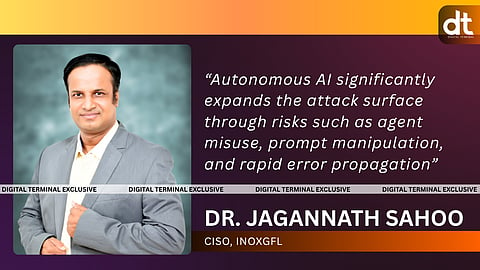
As enterprises integrate autonomous AI systems into their operations, Dr. Sahoo warns that the cybersecurity landscape will become significantly more complex. According to him, “Autonomous AI significantly expands the attack surface through risks such as agent misuse, prompt manipulation, and rapid error propagation. Attackers could leverage AI to automate vulnerability discovery, move laterally across systems, and exploit models at machine speed. Because of these risks, organizations must embed security directly into AI systems through identity controls, continuous monitoring, model governance, and human-in-the-loop checkpoints. Companies that treat AI security as an afterthought will face amplified operational and reputational risks, especially as intelligent systems begin to operate at scale across enterprise environments.”
Market Fears Around Disruption, Jobs, and Technology Risks
Dr. Sahoo acknowledged that the rapid pace of AI innovation has also created concerns about workforce disruption and systemic risks across industries. “Entry-level roles are likely to face disruption as AI begins to absorb routine tasks that were traditionally used for workforce grooming. At the same time, there is growing concern about the potential loss of human oversight in critical systems that operate at AI speed. Systemic risk is also increasing as opaque AI models influence decisions across sectors such as telecom, finance, and critical infrastructure. The real threat, however, is not AI adoption itself but unchecked AI deployment without proper governance and security rigor,” he explained.
Advice to Young Engineers Entering the Workforce
For young engineers beginning their careers during this transformative period, Dr. Sahoo believes the key to long-term success lies in focusing on skills that complement AI rather than compete with it. “Young professionals should not try to compete with AI on speed or volume, but instead focus on judgment, context, and responsibility. It is essential to build strong foundations in cybersecurity, data protection, and AI risk management alongside core engineering skills. Engineers must also learn how systems fail, how trust is established within technology ecosystems, and how digital systems impact society at scale. Those who can design, secure, and responsibly govern intelligent systems will play a defining role in the next decade of digital transformation,” he concluded.
𝐒𝐭𝐚𝐲 𝐢𝐧𝐟𝐨𝐫𝐦𝐞𝐝 𝐰𝐢𝐭𝐡 𝐨𝐮𝐫 𝐥𝐚𝐭𝐞𝐬𝐭 𝐮𝐩𝐝𝐚𝐭𝐞𝐬 𝐛𝐲 𝐣𝐨𝐢𝐧𝐢𝐧𝐠 𝐭𝐡𝐞 WhatsApp Channel now! 👈📲
𝑭𝒐𝒍𝒍𝒐𝒘 𝑶𝒖𝒓 𝑺𝒐𝒄𝒊𝒂𝒍 𝑴𝒆𝒅𝒊𝒂 𝑷𝒂𝒈𝒆𝐬 👉 Facebook, LinkedIn, Twitter, Instagram
