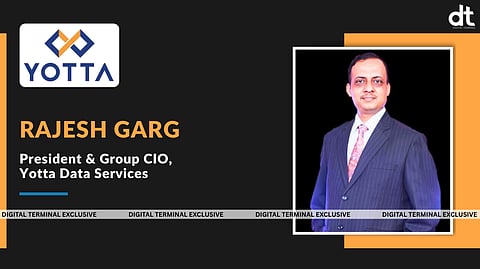

In an era where technology and business priorities are evolving faster than ever, CIOs are expected to be both strategic leaders and innovation enablers. Rajesh Garg, President & Group CIO, Yotta Data Services, operates at the forefront of this transformation. With extensive experience in digital innovation, cloud adoption, and cybersecurity, he brings a holistic perspective on how technology can drive operational excellence, business growth, and resilient digital ecosystems.
In this conversation, Rajesh reflects on his strategies for reallocating budgets toward innovation, simplifying complex technology landscapes, upskilling teams to blend technical expertise with business acumen, and navigating the evolving role of CIOs in the boardroom.
Q: How are you reallocating budgets from "keeping the lights on" to innovation (e.g., Agentic AI, cloud transformation, edge computing) while ensuring cost discipline?
A: We are optimizing operational and Opex costs while ensuring the lights stay on by migrating workloads to the cloud and adopting SaaS solutions, which reduces CapEx and maintenance expenses. AI-driven automation (AIOps) helps lower manpower requirements and downtime, while vendor consolidation eliminates redundant tools, cutting license costs. Simultaneously, we fund innovation without cost overruns by leveraging Agentic AI and GenAI for customer service, code co-pilots, threat detection, and process automation, investing in hybrid and multi-cloud setups for agility, and deploying edge computing to support IoT, low-latency applications, and AI inferencing at the edge. Cost discipline is maintained through FinOps practices, ROI-based project prioritization, and chargeback/showback models, ensuring accountability and measurable business outcomes.
Q: What strategies are you using to simplify technology complexity (e.g., legacy modernization, cloud consolidation)?
A: To simplify technology complexity, we focus on modernizing legacy systems, consolidating cloud environments, and standardizing platforms. Legacy modernization involves application rationalization by retiring redundant apps, consolidating platforms, and adopting cloud-native solutions, alongside API enablement and microservices to break monoliths into scalable, agile components. Low-code and no-code platforms further simplify development and reduce dependency on legacy codebases.
For cloud consolidation, we streamline workloads into hybrid and multi-cloud setups, optimize costs through FinOps and governance practices, and use containerization with Kubernetes to standardize deployments and reduce vendor lock-in. Finally, we drive standardization and integration by adopting unified platforms for collaboration, DevOps, and security, while leveraging AI-driven automation to predict failures and auto-remediate issues.
Q: How are you upskilling your team to blend technical expertise with business acumen?
A: We upskill our teams to blend technical expertise with business acumen through a combination of formal learning, experiential programs, and leadership development. Technical upskilling includes certifications in cloud platforms (AWS, Azure), AI/ML, cybersecurity, DevOps, and other emerging technologies. Experiential learning involves job rotations that move engineers into business-facing roles such as pre-sales and product strategy, along with shadowing and mentorship programs pairing technologists with business leaders to understand decision-making.
We embed business context into technology work by aligning projects with revenue growth, cost reduction, or customer satisfaction, running customer immersion programs, and forming agile, cross-functional fusion teams. Leadership development includes soft skills training, executive coaching for senior technologists, and succession planning to cultivate high-potential employees capable of bridging business and technology roles.
Q: How do you CIOs role evolving in the next few years? Is their presence well received in the boardroom?
A: The CIO role is evolving from traditional technology leadership to strategic business partnership. Modern CIOs not only “keep the lights on” but also shape revenue models through AI-driven products, digital services, and enhanced customer experiences, aligning IT investments directly with P&L impact. They lead digital and AI transformation initiatives—including GenAI adoption, cloud-native architecture, edge computing, and cyber resilience—while balancing innovation with cost discipline. Rising cyber and compliance risks mean CIOs often take on responsibilities similar to CISOs or Chief Risk Officers, including data ethics, privacy, and ESG-linked digital governance.
In the boardroom, CIOs are increasingly well-received but expected to speak in terms of growth, risk, and shareholder value. Acting as “digital translators,” they link technology to business resilience, revenue diversification, and competitive advantage. Many are evolving into Chief Digital Officers or strategic advisors, with their influence strongest when focused on outcomes rather than tools.
𝐒𝐭𝐚𝐲 𝐢𝐧𝐟𝐨𝐫𝐦𝐞𝐝 𝐰𝐢𝐭𝐡 𝐨𝐮𝐫 𝐥𝐚𝐭𝐞𝐬𝐭 𝐮𝐩𝐝𝐚𝐭𝐞𝐬 𝐛𝐲 𝐣𝐨𝐢𝐧𝐢𝐧𝐠 𝐭𝐡𝐞 WhatsApp Channel now! 👈📲
𝑭𝒐𝒍𝒍𝒐𝒘 𝑶𝒖𝒓 𝑺𝒐𝒄𝒊𝒂𝒍 𝑴𝒆𝒅𝒊𝒂 𝑷𝒂𝒈𝒆𝐬 👉 Facebook, LinkedIn, Twitter, Instagram
