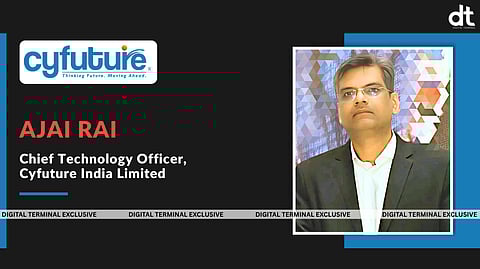

In an era where technology drives strategic advantage, organizations face the dual challenge of innovating rapidly while managing cost and complexity. Ajai Rai, Chief Technology Officer of Cyfuture India Limited, operates at the forefront of this transformative landscape. With deep expertise in cloud, AI, and edge computing, he brings a unique perspective on how technology can deliver measurable business value, simplify operations, and enable scalable innovation.
In this conversation, Ajai Rai reflects on the strategies behind reallocating budgets toward innovation, simplifying legacy technology landscapes, and building teams that combine technical expertise with business acumen.
Q: How are you reallocating budgets from "keeping the lights on" to innovation (e.g., Agentic AI, cloud transformation, edge computing) while ensuring cost discipline?
A: At Cyfuture, we’ve made a conscious effort to move beyond routine IT spend and invest in technologies that shape the future of our business. Over the past year, close to 30 percent of our traditional infrastructure cost has been redirected toward innovation particularly in areas such as Agentic AI, cloud automation, and edge-native computing. Our Cyfuture Cloud platform, built on a sovereign and hybrid framework, gives us the flexibility to innovate responsibly while maintaining cost discipline through FinOps-based governance. At the same time, Cyfuture AI has brought intelligence into daily operations from predictive maintenance to data-driven insights and personalized customer engagement.
New offerings such as GPU-as-a-Service, tiered cloud storage, and AI-driven cost-optimization tools are already helping our customers achieve higher performance, scalability, and resilience while reducing operational expenditure. Through Cyfuture AI, we’ve extended these capabilities further with a comprehensive suite of AI infrastructure and services including model-training environments, generative-AI frameworks, and industry-specific conversational AI solutions for banking, government, telecom, and manufacturing sectors.
Clients are leveraging these platforms to automate workflows, enable predictive decision-making, and elevate customer experience without heavy capital investment. With GPU-accelerated compute, data-aware orchestration, and FinOps-governed scaling, we are enabling enterprises to achieve high-value experiences at significantly lower cost. In essence, Cyfuture AI and Cyfuture Cloud together empower organizations to deliver more value per rupee - smarter, faster, and leaner.
Q: What strategies are you using to simplify technology complexity (e.g., legacy modernization, cloud consolidation)?
A: Simplification is often more powerful than addition. Over the past year, we have streamlined our technology stack by migrating over 40 percent of legacy workloads to a unified Cyfuture Cloud architecture. By adopting containerization, API-led connectivity, and service-mesh frameworks, we’ve eliminated unnecessary layers and brought clarity to our operations. This unified design gives us end-to-end visibility across infrastructure, applications, and security, improving agility and compliance. More importantly, it has created a foundation where next-generation workloads like AI/ML, data lakes, and edge analytics can run seamlessly and scale efficiently.
Q: How are you upskilling your team to blend technical expertise with business acumen?
A: Technology leadership today is about building teams that understand both systems and strategy. At Cyfuture, we’re developing professionals who are technically strong and business-savvy. Our TechForward Program combines certifications in cloud, AI operations, cybersecurity, and financial analytics with real-project exposure, encouraging teams to translate technology into measurable business outcomes. This shift from “building technology” to “building value” has been instrumental in creating a workforce that adapts quickly, takes ownership, and drives transformation with a clear sense of purpose.
Q: How do you CIOs role evolving in the next few years? Is their presence well received in the boardroom?
A: The CIO and CTO roles have changed dramatically. It’s no longer about running IT; it’s about shaping how the organization competes and grows. At Cyfuture, technology now influences everything from our go-to-market approach to customer experience and business model design. What’s encouraging is how technology leadership is being embraced at the board level. Discussions now focus on how digital capabilities can unlock growth rather than how much they cost. As we integrate AI, cloud, and automation deeper into our operations, the CTO’s role has become that of a strategic partner, guiding where to innovate, where to invest, and how to measure impact. Going forward, I believe technology leaders will act as co-architects of enterprise strategy, balancing innovation with accountability and turning digital ambition into tangible results.
𝐒𝐭𝐚𝐲 𝐢𝐧𝐟𝐨𝐫𝐦𝐞𝐝 𝐰𝐢𝐭𝐡 𝐨𝐮𝐫 𝐥𝐚𝐭𝐞𝐬𝐭 𝐮𝐩𝐝𝐚𝐭𝐞𝐬 𝐛𝐲 𝐣𝐨𝐢𝐧𝐢𝐧𝐠 𝐭𝐡𝐞 WhatsApp Channel now! 👈📲
𝑭𝒐𝒍𝒍𝒐𝒘 𝑶𝒖𝒓 𝑺𝒐𝒄𝒊𝒂𝒍 𝑴𝒆𝒅𝒊𝒂 𝑷𝒂𝒈𝒆𝐬 👉 Facebook, LinkedIn, Twitter, Instagram
