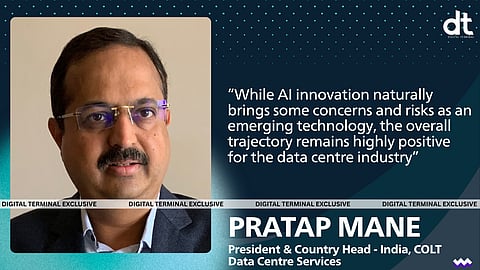

Artificial intelligence is not only transforming applications and enterprise workflows but is also reshaping the very foundation of digital infrastructure. As advanced AI models require unprecedented levels of compute power, the demand for scalable, high-performance, and energy-efficient data centres is rising rapidly. Pratap Mane, President & Country Head - India, COLT Data Centre Services, shares his perspective with DT on the implications of the latest AI advancements, the evolving role of engineers, industry outlook, and how young professionals can prepare for this shift.
AI Advancements Driving Urgency for Next-Gen Data Centre Infrastructure
Pratap Mane sees the launch of Anthropic’s latest AI model as a clear signal of the growing intensity of AI workloads. “Anthropic’s launch of Claude Opus 4.6 has been widely welcomed as a significant development in advanced AI capabilities. As these models grow more powerful, their high‑density compute needs are driving increases in demand for AI‑optimised digital infrastructure,” he said.
From an India perspective, he highlighted the urgency of scaling infrastructure. “For India, this reinforces the urgency of rapidly expanding AI‑ready data centre capacity to support the next generation of models and the broader ecosystem that will depend on them.”
Engineering Roles Evolving with AI-Driven Infrastructure Complexity
With AI becoming central to infrastructure design and operations, Pratap Mane pointed out that engineering roles are undergoing a significant transformation. “Engineering and technical roles are shifting quickly as AI becomes central to how digital infrastructure is designed and operated. AI‑driven workloads are pushing data centres toward higher power densities, advanced cooling, and greater automation, changing what engineers must build and manage,” he noted.
He explained that automation is redefining day-to-day responsibilities. “With Automation, this is reshaping day‑to‑day responsibilities. AI‑led monitoring, predictive maintenance, and intelligent resource allocation are enabling facilities to run more efficiently, moving engineers from manual oversight to supervising autonomous, AI‑powered systems. As a result, critical skills now include high-density infrastructure design, liquid cooling technologies, power optimisation, and AI‑assisted operations, along with the ability to integrate these into scalable, sustainable environments as India accelerates its AI adoption.”
Rising Demand Positioning Data Centres as Strategic AI Enablers
Addressing market concerns, Pratap Mane acknowledged that while emerging technologies often bring uncertainty, the outlook for the data centre sector remains highly positive. “While AI innovation naturally brings some concerns and risks as an emerging technology, the overall trajectory remains highly positive for the data centre industry. As AI models become more capable and compute‑intensive, demand for resilient, scalable and energy‑efficient digital infrastructure continues to rise,” he explained.
In the Indian context, he sees this as a major opportunity. “This rapid growth in AI‑driven workloads reinforces the strategic importance of high‑performance data centres in India, positioning the sector as a critical enabler of the next wave of technological advancement.”
Building Future-Ready Careers in an AI-Driven Infrastructure Landscape
Pratap Mane emphasized adaptability as the most critical trait. “For engineers entering the workforce today, the most important trait to develop is adaptability. AI is rapidly transforming how digital systems are designed, built, and maintained and employers are looking for people who can learn quickly and grow alongside these technologies,” he advised.
He highlighted the importance of combining technical depth with broader capabilities. “At the same time, there’s rising demand for engineers who can pair strong technical abilities with broader skills such as understanding business needs, communicating effectively, and collaborating across different disciplines. Therefore, my advice is to stay curious, keep strengthening your technical fundamentals, and build range in your skillset.”
He concluded with a forward-looking perspective. “Those who combine deep engineering knowledge with openness to continuous learning will be best prepared to succeed and lead in the new AI‑driven era.”
𝐒𝐭𝐚𝐲 𝐢𝐧𝐟𝐨𝐫𝐦𝐞𝐝 𝐰𝐢𝐭𝐡 𝐨𝐮𝐫 𝐥𝐚𝐭𝐞𝐬𝐭 𝐮𝐩𝐝𝐚𝐭𝐞𝐬 𝐛𝐲 𝐣𝐨𝐢𝐧𝐢𝐧𝐠 𝐭𝐡𝐞 WhatsApp Channel now! 👈📲
𝑭𝒐𝒍𝒍𝒐𝒘 𝑶𝒖𝒓 𝑺𝒐𝒄𝒊𝒂𝒍 𝑴𝒆𝒅𝒊𝒂 𝑷𝒂𝒈𝒆𝐬 👉 Facebook, LinkedIn, Twitter, Instagram
