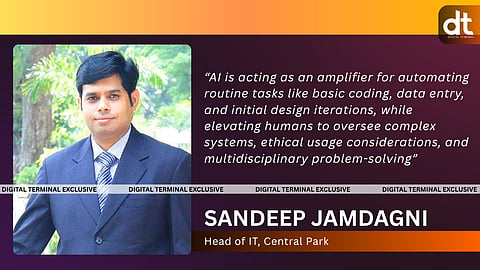

As artificial intelligence continues to redefine enterprise technology, organizations are increasingly focusing on how AI can move beyond automation to become a strategic enabler of innovation and efficiency. The emergence of advanced AI models has accelerated conversations around agentic workflows, ethical AI, and the future of engineering roles. While the market response reflects strong enthusiasm, it also brings attention to evolving skill requirements and emerging risks. In this context, Sandeep Jamdagni, Head of IT at Central Park, shares his perspective on the latest AI advancements, the transformation of technical roles, and how professionals can stay relevant in this rapidly changing landscape.
AI Advancements Driving More Human-Like and Ethical Systems
Sharing his perspective on the launch of Anthropic’s latest AI model, Sandeep Jamdagni explains, “Anthropic latest AI model emphasize improvements in long-context reasoning, agentic workflows like autonomously handling multi-step/stage activities and on ethical AI, essentially making the perspective of AI better at interacting with tools and environments in a more human-like way.”
He further adds, “Market reaction to Anthropic’s AI model is sky-high. Anthropic said to be focusing more on ethical AI, so it might be appealing more to the enterprises, where ethical usage and AI governance is talked about.”
Engineering Roles Becoming More Strategic and Skill-Driven
Discussing the transformation of engineering and technical roles in the AI era, Sandeep Jamdagni says, “In the AI era, engineering and technical roles are undergoing a profound shift from manual, repetitive execution to more strategic, integrative, and innovative work. Rather than absolute replacement, AI is acting as an amplifier for automating routine tasks like basic coding, data entry, and initial design iterations, while elevating humans to oversee complex systems, ethical usage considerations, and multidisciplinary problem-solving.”
He notes further, “AI skill shortage and making entry level skills redundant will shake the industry. AI/ML Fundamentals, Programming & Tools, Data & Analytics and Security & Ethics are the broad categories of skills which are going to be relevant in this era.”
Balancing AI Potential with Market Concerns and Risks
Highlighting the concerns emerging around rapid AI innovation, Sandeep Jamdagni remarks, “AI's true disruption lies in amplifying human potential to solve complex problems, not on creating an environment filled with fear of getting eradicated or making humankind irrelevant. Yet, responsible usage of AI and taking proactive measures like continuous and rapid self upskilling and building ethical frameworks, the market's fear of existent could become self-fulfilling.”
He further explains, “Rapid technology change risk is the major concern along with entry level job displacement due to automation of most of the repetitive activities. Technology risks extend to ethical and systemic threats, security vulnerabilities such as cyber threats, use of AI for destructive way like using AI for cyber crime related or fraud activities.”
Advice for Young Engineers Entering the AI Era
Offering advice to young engineers, Sandeep Jamdagni says, “My advice to young/fresh engineers and graduates is straightforward: embrace the shift as an accelerator for their career, not a barrier. Always be a learner, prioritize continuous learning and rapid upskilling yourself. Focus on AI fundamentals early—things like machine learning basics.”
He adds, “Master core technical skills that AI complements but doesn't fully replace like programming in Python/Rust, data handling with pandas or SQL etc. Be strong in tech fundamentals, build a hybrid mindset with tech skill like analytical thinking, collaboration, and ethical reasoning, keep networking with tech communities and have adaptability these are the skills where humans shine.”
𝐒𝐭𝐚𝐲 𝐢𝐧𝐟𝐨𝐫𝐦𝐞𝐝 𝐰𝐢𝐭𝐡 𝐨𝐮𝐫 𝐥𝐚𝐭𝐞𝐬𝐭 𝐮𝐩𝐝𝐚𝐭𝐞𝐬 𝐛𝐲 𝐣𝐨𝐢𝐧𝐢𝐧𝐠 𝐭𝐡𝐞 WhatsApp Channel now! 👈📲
𝑭𝒐𝒍𝒍𝒐𝒘 𝑶𝒖𝒓 𝑺𝒐𝒄𝒊𝒂𝒍 𝑴𝒆𝒅𝒊𝒂 𝑷𝒂𝒈𝒆𝐬 👉 Facebook, LinkedIn, Twitter, Instagram
