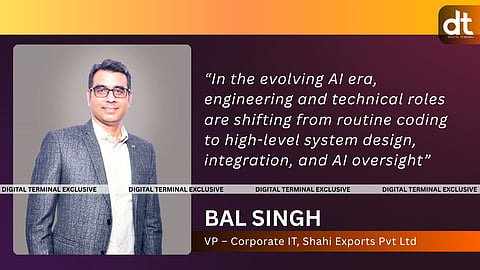

As artificial intelligence rapidly transitions from experimental innovation to enterprise-grade infrastructure, global technology leaders are closely evaluating its long-term impact on businesses, engineering roles, and workforce dynamics. The launch of Anthropic’s latest AI model has further intensified discussions around the growing capabilities of AI systems, particularly in reasoning, coding, and large-scale data processing. While market reactions have reflected both excitement and caution, industry experts believe the broader shift signals a deeper transformation in how organizations build technology, manage talent, and deliver value. While talking to DT, Bal Singh, VP – Corporate IT at Shahi Exports Pvt Ltd, shares his perspective on the evolving AI landscape, emerging market concerns, and how engineers can prepare for this new era of AI-driven innovation.
AI Moving from Experimentation to Enterprise Infrastructure
Bal Singh believes that the launch of Anthropic’s latest AI model represents a significant step forward in the evolution of practical artificial intelligence. “The launch of Anthropic’s latest AI model marks a significant milestone in the evolution of practical artificial intelligence. With stronger reasoning, improved coding assistance, and expanded long-context capabilities, this model reflects a transition from experimental tools to enterprise-grade infrastructure. This shift signals a faster integration of AI into daily workflows across engineering, research, and business operations.”
Bal Singh also pointed out that while technology markets have shown volatility following the announcement, such reactions are typical during periods of major technological disruption. “While current market volatility in technology and software stocks reflects uncertainty regarding disruption, I believe this is a reassessment of how AI will reshape cost structures and competitive advantages rather than a sign of structural damage. Historically, transformative technologies trigger short-term disruption before delivering long-term expansion,” he noted.
“In my view, while certain roles and business models will evolve, the broader impact will be positive—driving innovation, efficiency, and new opportunities across all sectors,” Bal Singh added.
The Transformation of Engineering Roles in the AI Era
Bal Singh believes engineers will increasingly move away from routine coding tasks toward higher-level responsibilities. “In the evolving AI era, engineering and technical roles are shifting from routine coding to high-level system design, integration, and AI oversight. The role is becoming increasingly strategic, focusing on systems thinking, cross-functional collaboration, and ensuring the reliability, security, and ethical use of AI tools,” he explained.
He further said, “To stay relevant, engineers must develop strong AI literacy, understanding how models work, their limitations, and how to integrate them effectively. While solid fundamentals in algorithms, data structures, and system design remain essential, data skills—including quality assessment and interpretation—are becoming critical.”
“Additionally, adaptability and continuous learning are vital as technologies evolve rapidly. Ultimately, strong communication and collaboration skills will differentiate engineers who can lead innovation in AI-augmented environments,” he added.
Rising Concerns Around Disruption and Technology Risks
Despite the excitement around AI’s potential, Bal Singh acknowledged that rapid innovation and automation have also triggered widespread concerns across industries and markets. He said, “Rapid AI innovation and automation have triggered several significant market concerns, primarily regarding job displacement in entry-level, routine, and administrative roles. There is a growing worry that workforce reskilling may not keep pace with these technological changes, potentially widening economic inequality.”
“Businesses are also concerned about disruptions to established revenue models, particularly in service and software industries where AI reduces reliance on human-driven processes. Consequently, investors remain cautious about which sectors will successfully adapt. Furthermore, technology risks—including data privacy breaches, cybersecurity threats, algorithmic bias, and misinformation—remain critical issues. These are compounded by regulatory uncertainty as governments work to develop responsible AI frameworks,” he explained.
“Ultimately, these concerns reflect a transitional period as the market balances AI's productivity potential against risks related to workforce impact, ethics, and systemic disruption, ” Bal Singh added.
Advice for the Next Generation of Engineers
Bal Singh believes the most important step is to embrace the shift rather than fear it. “For young engineers graduating during this historic wave of AI adoption, my advice is simple: do not fear the shift, but rather position yourself within it. Technology revolutions reward those who adapt early. I encourage you to make AI tools part of your daily workflow—viewing them not as competitors, but as collaborators that enhance your productivity and creativity,” he said.
He emphasized, “While tools evolve rapidly, core engineering principles remain timeless. It is essential to strengthen your fundamentals in algorithms, system design, data structures, and software architecture. Simultaneously, you should build AI literacy by understanding how models work, recognizing their limitations, and learning how to validate outputs responsibly. As you progress, focus on problem-solving rather than just coding. Develop your soft skills, such as communication, teamwork, and adaptability, as technical excellence alone is no longer enough in the current landscape.”
“Most importantly, commit to continuous learning. So I urge you to stay curious and build real-world projects. View this period not as a time of uncertainty, but as a rare opportunity to grow alongside transformative technology,” he concluded.
𝐒𝐭𝐚𝐲 𝐢𝐧𝐟𝐨𝐫𝐦𝐞𝐝 𝐰𝐢𝐭𝐡 𝐨𝐮𝐫 𝐥𝐚𝐭𝐞𝐬𝐭 𝐮𝐩𝐝𝐚𝐭𝐞𝐬 𝐛𝐲 𝐣𝐨𝐢𝐧𝐢𝐧𝐠 𝐭𝐡𝐞 WhatsApp Channel now! 👈📲
𝑭𝒐𝒍𝒍𝒐𝒘 𝑶𝒖𝒓 𝑺𝒐𝒄𝒊𝒂𝒍 𝑴𝒆𝒅𝒊𝒂 𝑷𝒂𝒈𝒆𝐬 👉 Facebook, LinkedIn, Twitter, Instagram
