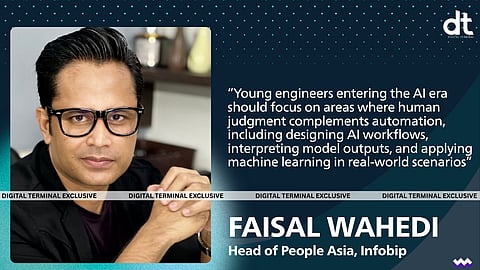

Artificial intelligence is moving beyond experimentation, with advanced models driving stronger reasoning, coding, and digital interaction capabilities. As adoption scales, organizations are embedding AI into core processes to improve efficiency, automate tasks, and deliver more personalized experiences, reshaping how businesses approach technology and talent. Faisal Wahedi, Head of People Asia at Infobip, shares his perspective on these shifts, the evolving role of engineers, key market concerns, and how young professionals can build meaningful careers in an AI-driven world.
AI Advancements Driving Real Business Impact
Faisal Wahedi views the launch of Anthropic’s latest model as a clear sign of AI’s transition into practical enterprise use. “Claude Sonnet 4.6 marks a major step forward in AI, showcasing stronger reasoning, coding, and digital interaction capabilities and illustrating how rapidly these models are evolving from experimental tools into practical business enablers,” he said.
He emphasized that this evolution is already influencing how organizations operate. “This evolution is already shaping how companies approach efficiency and decision-making, with brands embedding generative AI into communication platforms to automate routine tasks, generate actionable insights, and deliver more personalised experiences.”
At Infobip, this transformation is reflected in its own AI-driven platform. “For Infobip, this momentum is embodied in AgentOS, an AI-native orchestration platform that brings together agents, customer data, and omnichannel touchpoints to manage autonomous, context-aware customer journeys. Together, these developments highlight AI’s potential to strengthen digital engagement, optimize operations, and create meaningful value across every customer interaction.”
Engineering Roles Shifting Toward Intelligent System Design
As AI continues to mature, Faisal Wahedi believes engineering roles are evolving toward higher-value responsibilities. “As an AI-first company, we are seeing engineering and technical roles evolve as the technology takes on routine and repetitive tasks, allowing our teams to focus on designing, guiding, and optimizing intelligent systems across our communication and digital engagement platforms,” he explained.
He pointed out that engineers are increasingly working at a more strategic level. “This shift means engineers are increasingly framing complex problems, validating AI outputs, and ensuring solutions deliver tangible business impact. Critical skills include fluency with AI and data tools, interpreting and shaping model outputs, and strong problem-solving and creative thinking.
Collaboration, he noted, has become essential. “As AI is embedded in workflows. Engineers who embrace continuous learning and adaptability can drive innovation, streamline operations, and deliver more meaningful, high-impact solutions.”
Addressing Market Concerns Around AI and Automation
Faisal Wahedi acknowledged that rapid AI adoption is also raising important concerns across the market. “Market discussions around AI and automation highlight concerns about the pace at which tasks traditionally performed by humans may shift to machines, as well as questions around security, reliability, and governance,” he said.
He noted that organizations are actively evaluating how to manage this transition. “Organizations are evaluating how quickly workers can adapt and how technology risks can be mitigated. Addressing these challenges requires reskilling where needed, reinforcing oversight, and implementing protective measures.”
At Infobip, these concerns are addressed through a balanced approach. “At Infobip, these considerations are already embedded into AI deployments through human-in-the-loop models and structured governance, ensuring automation complements human expertise while supporting workforce development and enabling responsible, scalable integration of AI across operations.”
Preparing for the Future: Advice for Young Engineers
For young engineers entering the workforce, Faisal Wahedi emphasized the importance of focusing on areas where human skills add the most value. “Young engineers entering the AI era should focus on areas where human judgment complements automation, including designing AI workflows, interpreting model outputs, and applying machine learning in real-world scenarios,” he advised.
He stressed the need for continuous learning. “Continuous learning is crucial, from exploring new AI frameworks and coding practices to staying updated on emerging technologies. Developing collaboration and cross-disciplinary communication alongside technical skills is equally important, as most projects now involve diverse teams solving complex problems. Ethical awareness should guide every decision, ensuring AI is applied responsibly.”
He concluded with a forward-looking perspective. “Combining technical expertise with adaptability, critical thinking, and ethical practice will enable young engineers to navigate rapid AI adoption and make high-impact, meaningful contributions.”
𝐒𝐭𝐚𝐲 𝐢𝐧𝐟𝐨𝐫𝐦𝐞𝐝 𝐰𝐢𝐭𝐡 𝐨𝐮𝐫 𝐥𝐚𝐭𝐞𝐬𝐭 𝐮𝐩𝐝𝐚𝐭𝐞𝐬 𝐛𝐲 𝐣𝐨𝐢𝐧𝐢𝐧𝐠 𝐭𝐡𝐞 WhatsApp Channel now! 👈📲
𝑭𝒐𝒍𝒍𝒐𝒘 𝑶𝒖𝒓 𝑺𝒐𝒄𝒊𝒂𝒍 𝑴𝒆𝒅𝒊𝒂 𝑷𝒂𝒈𝒆𝐬 👉 Facebook, LinkedIn, Twitter, Instagram
