
Artificial Intelligence is rapidly transforming the global technology landscape, reshaping how organizations build systems, innovate, and deliver value across industries. What began as experimental deployments of machine learning models has now evolved into a powerful technological shift influencing nearly every sector of the economy. As enterprises explore how AI can improve productivity, enable automation, and unlock new business opportunities, technology leaders are also navigating important conversations around workforce transformation, responsible innovation, and long term technology strategy.
Ajai Rai, Chief Technology Officer at Cyfuture India, believes the current wave of AI development represents one of the most significant technological shifts since the rise of the internet. In this interaction with DT, he shares his perspective on the rapid evolution of AI models, the changing role of engineers, the concerns emerging around automation, and the mindset young engineers must adopt to thrive in this new era.
The AI Landscape Is Evolving at an Extraordinary Pace
Commenting on the launch of Anthropic’s latest AI model and the response it has generated in the market, Ajai Rai, Chief Technology Officer at Cyfuture India, told DT, “The release of Anthropic’s latest AI model is another clear indication of how quickly the AI landscape is evolving. Over the past couple of years, we have moved from experimenting with AI to seeing it become a central technology that is influencing almost every industry. Each new model seems to push the boundaries a little further—whether it is in reasoning, coding assistance, or the ability to process and understand vast amounts of information.”
“The market response has been enthusiastic, but also highly competitive. Every time a new model is introduced, it immediately triggers reactions across the technology ecosystem. Enterprises, startups, and developers begin evaluating how these capabilities can improve productivity, automate certain tasks, or enable entirely new types of applications,” he adds.
He observes, “What I find particularly interesting is that the discussion is gradually shifting. Earlier, the focus was mostly on which company had the most powerful model. Now the conversation is moving toward something more practical: who can actually apply AI in meaningful ways. Ultimately, the real impact of AI will not come from the model itself, but from how organizations integrate it into everyday systems—whether that is customer support, engineering processes, data analytics, healthcare platforms, or business decision-making.”
“From my perspective as a technology leader, these announcements should be seen less as individual breakthroughs and more as steps in a much larger transition toward AI-enabled and AI-assisted systems,” he explains further.
Engineers Will Evolve From Coders to System Architects
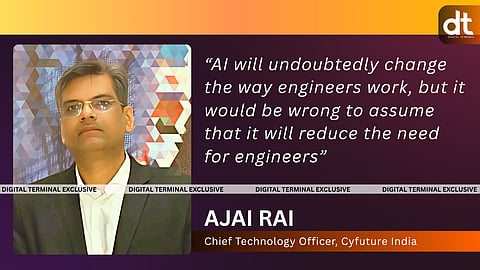
Sharing his perspective on how engineering roles are evolving in the age of AI, Ajai Rai says, “AI will undoubtedly change the way engineers work, but it would be wrong to assume that it will reduce the need for engineers. If anything, the opposite may happen. As systems become more sophisticated and interconnected, the demand for skilled engineers who understand how to design and manage complex technology environments will likely increase.”
“What is really changing is the nature of the work itself. In the past, engineers often spent a significant amount of time writing repetitive code, debugging routine issues, producing documentation, or carrying out manual testing. Today, AI tools are increasingly capable of assisting with many of these tasks,” he explains.
“Because of this, engineers will spend less time on routine coding and more time on higher-level thinking—designing system architectures, solving complex problems, and building platforms that integrate data, infrastructure, and AI models. In other words, the role of the engineer is gradually shifting from being purely a coder to becoming more of a system architect and technology problem-solver,” he notes.
He emphasizes, “To stay relevant in this changing environment, engineers will need to strengthen their understanding of areas such as AI and machine learning fundamentals, data engineering, cloud and distributed systems, cybersecurity, and automation practices. At the same time, technical knowledge alone will not be enough. Skills like critical thinking, creativity, and the ability to frame the right problem will become even more valuable. AI can generate answers very quickly, but it still relies heavily on humans to ask the right questions and provide direction.”
Balancing Innovation With Responsible AI Adoption
Discussing the concerns emerging around rapid AI innovation and automation, Ajai Rai remarks, “Like every major technological shift, the rapid progress in AI has created both excitement and anxiety. Many industries are enthusiastic about the possibilities, but there are also understandable concerns about disruption and the pace of change. One of the most widely discussed concerns is job displacement, particularly for entry-level roles in areas such as software development, customer support, or data processing.
Automation will certainly reshape some roles. However, if we look at previous technological revolutions—from the internet to cloud computing—we can see that technology tends to transform jobs rather than simply eliminate them. As some roles evolve or disappear, entirely new roles often emerge.”
“Another topic that frequently comes up is the concentration of AI capabilities within a relatively small group of global technology companies. This raises important questions around issues such as data governance, digital sovereignty, and long-term technological independence for different countries and organizations. There are also valid concerns about the misuse of AI, including misinformation, cyber threats, or unethical applications of advanced technologies. As AI systems become more powerful, responsible governance and thoughtful deployment become extremely important,” he explains.
“For technology leaders and organizations, the challenge is to strike the right balance—encouraging innovation while ensuring that AI is used responsibly and ethically,” he emphasizes.
Advice for Young Engineers Entering the AI Era
Offering advice to young engineers who are beginning their careers during this period of rapid technological change, Ajai Rai said, “For engineers graduating today, this is actually a remarkable moment to begin a career in technology. They are entering the industry at a time when the entire technology landscape is being reshaped. My first piece of advice would be to view AI as an opportunity rather than a threat. Engineers who learn how to use AI tools effectively will be able to work faster, experiment more, and solve problems in new ways.”
He further added, “Second, it is important not to neglect the fundamentals. Core concepts such as algorithms, system design, networking, and security remain extremely valuable and will continue to form the foundation of strong engineering careers. Third, young engineers should focus on building real things. Working on practical projects—whether open-source contributions, prototypes, or personal applications—provides far deeper learning than simply studying tools or frameworks.”
“Another important mindset is continuous learning. Technology is evolving faster than ever, and the engineers who succeed will be those who remain curious and adaptable throughout their careers,” he added.
He explains, “Finally, it is important to remember that technology ultimately exists to solve real problems for people. Engineers who combine technical expertise with creativity, empathy, and an understanding of business needs will be able to create the most meaningful impact.”
The Road Ahead
Looking ahead at the broader impact of artificial intelligence on the technology ecosystem, Ajai Rai noted, “We are currently witnessing one of the most significant shifts in technology since the rise of the internet. AI is no longer just another software tool—it is gradually becoming a foundational layer of modern computing.”
“The future will not be defined by humans competing with machines, but by humans learning how to work alongside intelligent systems. Engineers who embrace this shift and learn how to collaborate with AI will remain highly relevant and will play an important role in shaping the next generation of technology innovation,” he concluded.
𝐒𝐭𝐚𝐲 𝐢𝐧𝐟𝐨𝐫𝐦𝐞𝐝 𝐰𝐢𝐭𝐡 𝐨𝐮𝐫 𝐥𝐚𝐭𝐞𝐬𝐭 𝐮𝐩𝐝𝐚𝐭𝐞𝐬 𝐛𝐲 𝐣𝐨𝐢𝐧𝐢𝐧𝐠 𝐭𝐡𝐞 WhatsApp Channel now! 👈📲
𝑭𝒐𝒍𝒍𝒐𝒘 𝑶𝒖𝒓 𝑺𝒐𝒄𝒊𝒂𝒍 𝑴𝒆𝒅𝒊𝒂 𝑷𝒂𝒈𝒆𝐬 👉 Facebook, LinkedIn, Twitter, Instagram
