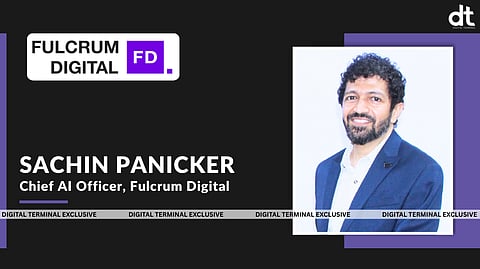

The next frontier of AI is here, Agentic AI, where intelligent systems move beyond analysis to autonomous action. It’s transforming how enterprises operate, collaborate, and innovate. In this interview, Sachin Panicker, Chief AI Officer at Fulcrum Digital, shares his perspective on this shift, highlighting real-world adoption, emerging risks, and strategies for responsible enterprise integration.
Q: How do you see the rise of Agentic AI, and what sets it apart from conventional AI in enterprise cases?
A: Conventional AI has been like a sharp analyst, largely reactive—it waits for your question, processes data, and gives an answer or performs pre-defined tasks. Agentic AI, in contrast, acts more like a proactive colleague. It doesn’t just respond; it initiates, reasons across tasks, and coordinates with other systems to deliver outcomes. It changes the game by moving from being tool-centric to outcome centric and from operating in isolation to working collaboratively across systems and teams. These shifts make Agentic AI a true game-changer in enterprise use cases and transforms AI from a clever tool into a true digital teammate— one that doesn’t just inform decisions but actively drives them.
Q: Which major verticals are leading the adoption of Agentic AI and why?
A: Industries where decisions and processes are complex, time-sensitive, and highly personalized are naturally embracing Agentic AI first. In financial services, managing portfolios, detecting fraud, etc. requires rapid, coordinated decision-making. These are the tasks where Agentic AI can make a tangible difference. The Insurance sector is experimenting with claims processing and customer service orchestration, letting AI agents handle repetitive yet critical workflows while humans focus on judgment-heavy cases. In retail and e-commerce, Agentic AI is becoming a digital sales partner, curating recommendations, personalizing offers, and guiding customers through their buying journey.
Healthcare, too, is exploring agents to coordinate patient care, streamline scheduling, and reduce administrative overheads, freeing clinicians to focus on patients. What ties these sectors together as front-runners of Agentic AI adoption is a shared need: environments where agility, personalization, and collaboration matter, and where agents can not just assist but actively drive meaningful outcomes. However, human oversight remains essential. Agents can drive actions, but humans must guide, validate, and intervene when critical decisions are at stake.
Q: What cybersecurity risks or governance concerns do you foresee with Agentic AI deployments?
A: As the famous saying goes, ‘With great power comes great responsibility’, and in the case of Agentic AI, that power is autonomy. Agentic AI can take actions across systems at a speed and scale humans can’t match, which is both its strength and its risk. A misconfigured agent could inadvertently expose sensitive data, execute unintended transactions, or make huge errors before anyone notices. Beyond security, governance becomes more than just tracking model accuracy—it’s about trust, transparency, and accountability. Organizations will need clear guardrails, continuous monitoring, and well-defined human-in-the-loop checkpoints to ensure that agents remain reliable partners rather than unpredictable actors during the deployment and their usage.
Q: One piece of advice you’d offer to CIOs planning to integrate Agentic AI into their digital roadmap?
A: My advice to the CIOs would be to start small, but design for scale. Begin with pilots where measurable value is clear— such as automating customer query resolution or internal workflow orchestration. This will ensure that the organisation learns, adapts and builds confidence in Agentic AI. At the same time, invest in the culture, processes and governance to allow these agents to scale safely. Think of an agent as a new team member: you would not hand over critical projects without setting any expectations, providing necessary guidance or keeping an eye on the progress. Treat AI agents in similar way- define clear boundaries, maintain human oversight, and continuously refine their capabilities. This will unlock not just efficiency but a new class of digital co-workers who can elevate human creativity and enterprise outcomes.
Leader Uncovered:
Education: Bhilai Institute of Technology (BIT), Durg (2000)
Certifications: None
Birth Place: Ernakulam, Kerela
First Job: Senior Software Engineer at Infosys
Strength: Clear and direct communicator with strong empathy, resilience, and resourcefulness. Focused on meaningful connections and driven to find creative solutions with genuine intent.
Weakness: Strong empathy can make me emotionally affected by others’ struggles, sometimes impacting my focus.
Biggest inspiration: Family’s resilience, Nelson Mandela’s forgiveness, Marie Curie’s scientific brilliance, and Ayn Rand’s philosophy of individuality and strength.
One passion or hobby: Trail running, Drumming, Foodie, Reading, Traveling, Movie Buff
𝐒𝐭𝐚𝐲 𝐢𝐧𝐟𝐨𝐫𝐦𝐞𝐝 𝐰𝐢𝐭𝐡 𝐨𝐮𝐫 𝐥𝐚𝐭𝐞𝐬𝐭 𝐮𝐩𝐝𝐚𝐭𝐞𝐬 𝐛𝐲 𝐣𝐨𝐢𝐧𝐢𝐧𝐠 𝐭𝐡𝐞 WhatsApp Channel now! 👈📲
𝑭𝒐𝒍𝒍𝒐𝒘 𝑶𝒖𝒓 𝑺𝒐𝒄𝒊𝒂𝒍 𝑴𝒆𝒅𝒊𝒂 𝑷𝒂𝒈𝒆𝐬 👉 Facebook, LinkedIn, Twitter, Instagram
