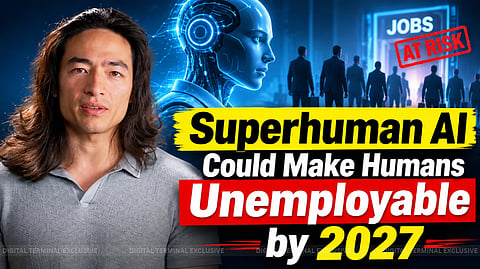

Artificial intelligence could eventually reach a level where humans struggle to remain competitive in the job market, an Anthropic researcher has warned, raising fresh questions about the long-term consequences of increasingly capable AI systems. The researcher has pointed to 2027 as a possible milestone for the emergence of superhuman AI, a development that could significantly change how businesses operate and how people earn a living.
According to media reports, the transition could initially push people out of their existing professions as AI takes over a growing share of tasks. Workers displaced from familiar roles may need to seek alternative occupations, although the longer-term availability of jobs remains uncertain.
The warning comes amid rapid advances in AI models that can perform increasingly complex tasks involving software development, research, analysis and other knowledge-based work. While AI adoption has so far produced a mix of automation, productivity gains and changing job responsibilities, the prospect of systems matching or exceeding top human experts across a broad range of fields presents a more disruptive possibility.
Superhuman AI Could Redefine Professional Work
The term superhuman AI generally refers to systems capable of matching or outperforming the best human experts across a wide range of intellectual tasks. Such capabilities could extend AI's role beyond assisting employees to independently completing work that currently requires specialist knowledge, experience and judgement.
If AI systems reach this level, industries that rely heavily on cognitive labour could face significant changes. Software engineering, financial analysis, research, consulting, customer support and several administrative functions are among the areas where advanced automation could reshape job requirements.
The immediate effect may not necessarily be the disappearance of entire professions. Instead, AI could automate specific responsibilities within jobs, reduce the number of employees required for certain tasks and change the skills employers value. However, if AI becomes capable of handling most tasks across multiple occupations, workers could find it increasingly difficult to transition into alternative roles.
The possibility of permanent unemployability represents a more extreme outcome than the job displacement associated with previous technological shifts. It would depend on how capable AI systems become, how quickly businesses adopt them and whether new forms of employment emerge to absorb displaced workers.
Why the 2027 Prediction Matters
The 2027 timeline has drawn attention because it suggests that the transition to highly capable AI could happen much sooner than many organisations and governments are prepared for. However, it should be treated as a forecast rather than a confirmed deadline. The arrival of superhuman AI by that year is not an established certainty, and experts continue to debate the pace and limits of AI progress.
Businesses are already exploring AI to improve productivity, automate repetitive processes and reduce the time required to complete complex tasks. If future systems become substantially more capable, companies could reconsider workforce structures, hiring plans and investments in employee training.
For workers, this could increase the importance of adaptability, technical literacy and the ability to work effectively alongside AI tools. Yet reskilling alone may not resolve the problem if AI eventually performs a broad range of tasks more efficiently than human employees.
The Employment Challenge Goes Beyond Automation
The broader concern is whether economic systems can adapt quickly enough to a labour market transformed by advanced AI. Potential responses could include stronger social safety nets, changes to education and workforce development, and new approaches to distributing the economic gains generated by automation.
Governments, employers and technology companies may also face growing pressure to assess the effects of AI deployment on employment, wages and economic inequality.
Ultimately, the central question is not simply how many jobs AI can automate, but whether new opportunities will emerge quickly enough to replace the work it displaces. If AI capabilities advance at the pace some researchers anticipate, preparing for that transition could become one of the most important economic challenges of the coming years.
𝐒𝐭𝐚𝐲 𝐢𝐧𝐟𝐨𝐫𝐦𝐞𝐝 𝐰𝐢𝐭𝐡 𝐨𝐮𝐫 𝐥𝐚𝐭𝐞𝐬𝐭 𝐮𝐩𝐝𝐚𝐭𝐞𝐬 𝐛𝐲 𝐣𝐨𝐢𝐧𝐢𝐧𝐠 𝐭𝐡𝐞 WhatsApp Channel now! 👈📲
𝑭𝒐𝒍𝒍𝒐𝒘 𝑶𝒖𝒓 𝑺𝒐𝒄𝒊𝒂𝒍 𝑴𝒆𝒅𝒊𝒂 𝑷𝒂𝒈𝒆𝐬 👉 Facebook, LinkedIn, Twitter, Instagram